Former Watchdogs Oppose Comptroller General Nominee Eric Ueland
Twenty-one former IGs signed onto a letter raising concerns about the unusual process that led to Ueland’s nomination, as well as his independence and potential conflicts.

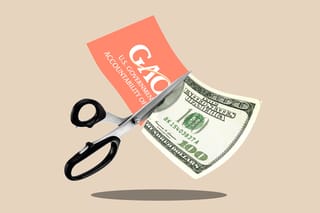
(Illustration: Luna Velez / POGO)
A group of former inspectors general is urging congressional leaders to reject the president’s nomination of Eric Ueland for the position of Comptroller General of the United States. The IGs raise concerns about Ueland’s qualifications and potential conflicts of interest, and they warn that bypassing established safeguards will threaten the independence of the country’s top nonpartisan government watchdog.
For more than four decades, Congress has recognized the necessity of an independent, nonpartisan Comptroller General to lead the Government Accountability Office (GAO), an important oversight office that provides information for Congress and makes recommendations to make government more effective and save the American people money.
The group’s letter emphasizes that a deliberate, bipartisan vetting process is an essential safeguard to ensuring the next Comptroller General will serve with integrity and have the public’s trust. POGO, too, has raised alarms about this year’s extraordinary nomination process for the position, which unfolded in days rather than the customary months.
If Congress is serious about rooting out waste, fraud, and abuse, they must prioritize the integrity of the GAO, commit to the statutory process, and fully vet the independence and qualifications of the Comptroller General nominee.
Read the letter from the inspectors general letter below.
Date: November 17, 2026
The Honorable Rand Paul
Chairman
Committee on Homeland Security and Governmental Affairs
United States Senate
Washington, DC 20510
The Honorable Gary C. Peters
Ranking Member
Committee on Homeland Security and Governmental Affairs
United States Senate
Washington, DC 20510
Re: Former Inspectors General Opposition to the Nomination of Eric Matthew Ueland to be Comptroller General of the United States
Dear Chairman Paul and Ranking Member Peters:
As former federal Inspectors General who have dedicated our careers to independent, nonpartisan oversight of the federal government, we write to express our strong opposition to the nomination of Eric Matthew Ueland to serve as Comptroller General of the United States and head of the Government Accountability Office (GAO). Across administrations of both parties, our community has seen firsthand that the credibility of any oversight institution depends on two pillars: strict adherence to statutory safeguards designed to protect its independence, and leadership defined by proven, nonpartisan fidelity to objective evidence. Mr. Ueland's nomination fails on both counts.
1. Subversion of the Statutory Bipartisan Selection Process
Unlike executive-branch officials who serve at the pleasure of the President, the Comptroller General leads a legislative-branch agency—Congress's primary investigative and audit arm—for a single, non-renewable 15-year term spanning four presidential administrations. Recognizing the extraordinary reach of that tenure, Congress enacted the General Accounting Office Act of 1980 (31 U.S.C. § 703) to ensure that any nominee enjoys broad, bipartisan confidence. The statute establishes a 10-member bicameral, bipartisan congressional commission tasked with vetting candidates and recommending at least three qualified individuals to the President.
For nearly a year following former Comptroller General Gene Dodaro's retirement at the end of 2025, that commission failed to conduct a meaningful, bipartisan search—a stark departure from the deliberative, multi-month bipartisan vetting processes that produced Comptrollers General Charles Bowsher, David Walker, and Gene Dodaro. Instead, during a post-election lame-duck session, after affording congressional minority leaders fewer than 24 hours to submit names, the administration and Senate leadership are attempting to rush through a sitting White House official just days after his formal nomination and weeks before a change in Senate control. Truncating a 15-year institutional appointment into a last-minute partisan exercise undermines the legitimacy of the office.
2. Irreconcilable Conflicts of Interest and Threat to GAO's Independence
GAO's constitutional and statutory mandate requires it to audit executive-branch spending without fear or favor, issue objective legal opinions on appropriations law, and enforce the Impoundment Control Act—including bringing civil enforcement actions against the executive branch when appropriated funds are unlawfully withheld.
Mr. Ueland currently serves as Deputy Director for Management at the White House Office of Management and Budget (OMB)—the very agency whose spending freezes and impoundments GAO has repeatedly found unlawful over the past two years. Alongside his senior role under OMB Director Russell Vought, Mr. Ueland has concurrently served in acting leadership capacities overseeing the dismantling of the U.S. Agency for International Development and previously at the Office of Government Ethics, while publicly describing the continued reduction of the federal workforce as his "priority number one."
Installing OMB's second-ranking official to lead GAO creates an acute, irreconcilable conflict of interest. If confirmed, Mr. Ueland would immediately oversee ongoing GAO audits of the exact budget impoundments, workforce reductions, and agency restructurings he helped architect and defend, while holding unilateral authority over whether GAO enforces the Impoundment Control Act against his former White House colleagues. Even widespread recusals could not cure a conflict that reaches the core of GAO's docket, nor could they restore public and congressional trust that GAO's legal and audit findings are free from executive-branch influence.
3. Absence of Nonpartisan Audit and Watchdog Qualifications
Leading GAO's workforce of more than 3,000 auditors, evaluators, economists, and attorneys demands deep, demonstrated expertise in Generally Accepted Government Auditing Standards, financial management, program evaluation, and independent oversight leadership. While Mr. Ueland has extensive experience in partisan Senate floor strategy, legislative affairs, and executive-branch management, his career reflects political advocacy rather than nonpartisan audit or investigative stewardship. As the oversight community has repeatedly emphasized in recent confirmation debates, procedural fluency and loyalty to an administration are no substitute for an established record of independent, evidence-based accountability.
For more than a century, GAO has earned the trust of Congress and the American people because its leaders stood apart from partisan politics. Confirming a sitting White House political official through a rushed, unilateral process would inflict lasting damage on one of Congress's most vital institutional checks. We respectfully urge the Committee to oppose Mr. Ueland's nomination, restore the bipartisan 31 U.S.C. § 703 commission process, and insist upon a consensus, career-caliber watchdog worthy of this critical office.
Sincerely,
Brett Baker
Former Inspector General, National Archives and Records Administration
Michael R. Bromwich
Former Inspector General, Department of Justice
David B. Buckley
Former Inspector General, Central Intelligence Agency
Kathy A. Buller
Former Inspector General, Peace Corps
Eric R. Feldman
Former Inspector General, National Reconnaissance Office
Phyllis K. Fong
Former Inspector General, Department of Agriculture, Small Business Administration
Mark Greenblatt
Former Inspector General, Department of the Interior
Christi A. Grimm
Former Inspector General, Health and Human Services
Thomas Howard
Former Inspector General, Amtrak
Deborah Jeffrey
Former Inspector General, AmeriCorps, Securities and Exchange Commission
Allison Lerner
Former Inspector General, National Science Foundation
Paul Martin
Former Inspector General, US AID, NASA
Michael J, Missal
Former Inspector General, Department of Veterans Affairs
Thomas A. Monheim
Former Inspector General, Intelligence Community
David A. Montoya
Former Inspector General, Department of Housing and Urban Development
Jenny Banner Rone
Former Acting Inspector General, Department of Agriculture
John Roth
Former Inspector General, Department of Homeland Security
Cynthia Schnedar
Former Acting Inspector General, U.S. Department of Justice
John F. Sopko
Former Special Inspector General for Afghanistan Reconstruction
Eric Thorson
Former Inspector General, Small Business Administration, Treasury
Robert Westbrooks
Former Inspector General, Pension Benefit Guaranty Corporation
Related Content
Rush to Confirm a Top Watchdog Could Be an Attempt to Curtail Oversight into the Trump Administration
Nominating an independent and effective comptroller general is key to delivering the oversight Americans voted for, says outside watchdog.