Accountability Groups to Congress: Ban Insider Trading on Prediction Markets
The Senate has passed a resolution banning members from profiting via insider trading on prediction markets. It’s time the House did the same.
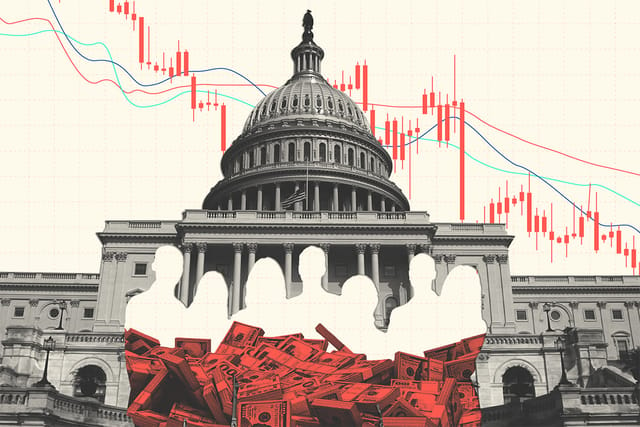
(Illustration: Luna Velez / POGO)
Dear Members of Congress,
The proliferation of suspicious activity and insider trading on prediction markets undermines the public’s trust in the federal government, and Congress must respond with binding legislation. On April 30, 2026, the Senate unanimously approved a resolution that would ban senators and their staff from trading on prediction markets.1 The Project On Government Oversight (POGO) and the undersigned organizations urge the House of Representatives to do the same, effectively prohibiting all members of Congress and their staff from trading on prediction markets.
There has been a steady demand from House representatives to act. On May 22, Representative James Comer (R-KY) launched an investigation into how users on prediction market platforms potentially utilize insider information to gain an unfair advantage.2 And on June 3, Representatives Kevin Mullin (D-CA) and Gabe Vasquez (D-NM) led a group of lawmakers to call for the Federal Trade Commission to investigate whether prediction markets “are engaging in unfair and deceptive practices.”3 These developments reflect a growing recognition of the dangers posed by prediction markets and a demand for clearer laws and regulations.
Members of both parties agree that no one in Congress should be allowed to profit from insider knowledge via prediction markets. In addition to the bipartisan effort to launch investigations, Representative Dina Titus (D-NV) introduced a House resolution similar to that of the Senate’s at the end of April.4 Roughly one week later, Representative Ashley Hinson (R-IA) proposed legislation to change House rules to effectively ban members and their staff from participating in prediction markets.5 To date, at least four bipartisan bills have been introduced in the span of four months.6
The consensus also reflects a shared goal that goes beyond banning members of Congress and their staff from trading in these markets. Congress acknowledges two additional gaps: first, that certain event contracts should be explicitly prohibited as they’re considered to be contrary to the public interest and second, that government officials and employees across all three branches should be prohibited from engaging in these markets, with no carve-outs for contract type.
Unlike the securities market, insider trading protections for event contracts are not as robust.7 Trading material nonpublic information on prediction markets is rather untested. A partial ban or narrow prohibition would fall short of comprehensively addressing insider trading risks. This is especially clear when taking the nature of Congress’s work into account, in which members and staff are continuously exposed to nonpublic information spanning a wide range of policy areas. Without clearly defined terms and meaningful enforcement, a narrow ban would simply shift exploitable opportunities rather than eliminate them.
Prediction markets have already proven to pose risks to government integrity, as individuals working for a political campaign recently reported betting on their own candidate on prediction markets and winning thousands of dollars.8 In an election year, we anticipate more markets offering contracts tied to government actions and electoral outcomes.9 As POGO noted in a public comment to the Commodity Futures Trading Commission, permitting such contracts creates financial incentives and conflicts of interest that threaten election integrity and undermine confidence in the democratic process.10
A broad government ban should be the first foundational step toward rooting out insider trading through prediction markets. Anything less would leave the law vulnerable to loopholes. Alongside or following that, certain event contracts must be explicitly prohibited from being traded on prediction market platforms, as they naturally pose systemic risks to our democratic integrity, national security, and public safety.11
The Senate has demonstrated its commitment to protecting the legislative branch from insider trading, and they agree that the House of Representatives should follow suit.12 Governing to win a bet is corrupt. The public deserves to trust that their government will act on principle, not on the potential for officials and employees to profit from prediction markets during their time in public service. Congress must lead by example. We urge the House to join the Senate in passing a resolution that bans all members and their staff from engaging in prediction markets.
Signed by:
- Americans for Financial Reform
- Citizens for Responsibility and Ethics in Washington (CREW)
- Demand Progress
- Fix the Court
- Fix Our House
- Issue One
- Project On Government Oversight
- Public Citizen
- SMART Legislation