Public Comment: CFTC Must Meaningfully Regulate Prediction Markets
Through regulatory reforms, the CFTC can protect the public interest by addressing prediction markets’ potential for corruption.
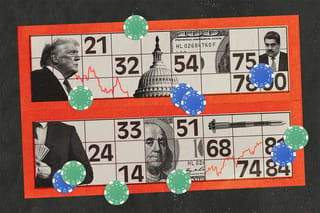
(Illustration: Luna Velez / POGO)
To:
- Christopher Kirkpatrick
Secretary of the Commission
Commodity Futures Trading Commission
Three Lafayette Centre
1155 21st St. NW
Washington, DC 20581 - Via electronic submission: https://comments.cftc.gov/PublicComments/ReleasesWithComments.aspx
Re: Advance Notice of Proposed Rulemaking, RIN 3038-AF65
Dear Secretary Kirkpatrick:
The Project On Government Oversight (POGO) submits the following comment to the Commodity Futures Trading Commission (CFTC) concerning the Advance Notice of Proposed Rulemaking regarding event contract derivatives traded on prediction markets.1 POGO is a nonpartisan, independent watchdog that investigates, exposes, and champions reforms on systemic corruption, abuse of power, and waste.2
POGO urges the Commission to specify that event contracts related to death, political events, or electoral outcomes, as well as event contracts that create incentives for government officials to trade on Material Nonpublic Information (MNPI), are “contrary to the public interest” under the CFTC’s Commodity Exchange Act (CEA) authority. In addition, we urge the Commission to strengthen pre-listing review for these and other categories of event contracts that implicate significant public interest concerns.
Specify That Certain Event Contracts Are Contrary to the Public Interest
Response to Questions C.8, C.13, C.20, and C.21 in CFTC Public Comment Request on Advance Notice of Proposed Rulemaking Relating to Prediction Markets.
Under the CEA, the CFTC may ban public trading on certain contracts by determining that such contracts are against the public interest.3 The statute specifically lists contracts that involve activities that are “unlawful under any Federal or State law” or are related to “terrorism,” “assassination,” “war,” or “gaming” as those which may be banned, in addition to other “similar” contracts deemed against the public interest by the CFTC.4 As described below, the rise of online prediction markets has created meaningful risks of insider trading and corruption, with consequences that are against the public interest.
The Commission should clarify that any bets related to death, political events, or electoral outcomes, as well as bets dependent on government actions that create incentives for government officials to trade on MNPI, are contrary to the public interest and are expressly prohibited. In doing so, the Commission would be better equipped to address any potential abuse of such contracts and provide much-needed guidance to prediction market platforms and users.
Contracts Related to Death
Contracts dependent on the death of or physical harm to any individual are clearly against the public interest. Such contracts reduce the value of human life by turning real people’s physical well-being into the gamified object of interest for online traders looking to enrich themselves. In addition to physical risk, individuals who are commodified by such betting may fear for their safety, enduring a significant psychological toll, as well as the possible financial toll as they seek out ways to increase their security. This fear speaks to a broader impact on society as a whole, as these contracts could incentivize violent behavior, including assassinations and other physical assaults, in order to impact the success of placed bets.
These contracts are also likely to implicate government actions affecting national security and political leaders, as exemplified by recent prediction market betting on the death of Iranian Supreme Leader Ali Khamenei.5 This betting may therefore reduce trust in government decision-making and could incentivize government workers to abuse MNPI, as further discussed below.
Contracts Related to Political Events and Electoral Outcomes6
Contracts tied to political events and electoral outcomes could erode the public’s trust in the fairness of political systems, incentivize potential election interference, and introduce anti-democratic financial incentives that could sway voters’ decision-making. When votes potentially translate to a profit, such contracts put the democratic process up for sale. Electing the best candidate would no longer be the only incentive for voters. As long as event contracts on electoral outcomes are permitted, possible financial incentives and conflicts of interest will always threaten election integrity. These problems could especially be a threat in small or close elections, in which several thousand votes may sway the political outcome. Similarly, contracts placed on the outcomes of other types of political events — such as political nominations or the outcome of regulatory adjudications — undermine public confidence in the democratic process.
Members of Congress, regulators, and experts in economics and law have all expressed their concerns about mixing politics with event contracts.7 In order to protect the actuality and appearance of free and fair elections and ensure the irreproachability of political events, contracts involving political events and electoral outcomes must be classified as being against the public interest.
Contracts Dependent on Government Actions that Encourage Government Insiders to Trade on MNPI
Contracts that depend on government actions and encourage government insiders to trade on MNPI incentivize government employees and contractors to subvert the fairness of markets by using confidential information to gain an advantage. Further, they undermine public trust and may lead to significant national security risks by revealing sensitive classified information through trading. Such contracts are dependent on the occurrence of specific government actions, ranging from individual agency rulings to foreign military interventions. While certain market platforms like Kalshi and Polymarket have updated their rules and certain government ethics rules prohibit federal workers from leveraging non-public information to place such bets, violations of these rules are usually punishable by internal agency disciplinary action, which may be insufficient deterrence in the face of lucrative financial incentives.8
Recently, U.S. soldier Gannon Ken Van Dyke was charged with unlawful use of confidential government information for personal gain, fraud, and making an unlawful monetary transaction.9 Van Dyke allegedly placed bets on the capture of Venezuelan President Nicolás Maduro while he was involved in the operation himself. This bet first gained media attention in January 2026 during the lead-up to the U.S. operation to capture Maduro. An anonymous Polymarket user placed a bet that Maduro would be out of power by the end of the month, just hours before U.S. troops landed in Venezuela.10 The anonymous user earned over $400,000. Public reporting has questioned whether these bets, which may have relied on classified information, could have risked U.S. troops during the operation, as any Polymarket observer could have detected the unusual trading activity.11
Another recent example that raised suspicions of misused MNPI involved a surge of bets, worth half a billion dollars, that were placed 15 minutes before President Donald Trump posted on Truth Social about a “complete and total resolution” to hostilities with Iran on March 23, 2026.12 Whether or not MNPI was misused, the appearance of impropriety undermines prediction market fairness and official government decisions.
Given the dangerous, unethical state of affairs created by exchange contracts related to death, specific electoral outcomes, and political events, and contracts that depend on government actions and create incentives for government officials to trade on MNPI, the Commission should act decisively to specify that such contracts are against the public interest. Further, the CFTC should implement prevention tools to flag and prohibit any platform from trading on such contracts.
Strengthen Pre-Listing Review for High-Risk Contracts
Response to Questions D.23, D.24, D.27, C.21, E.29, and E.32 in CFTC Public Comment Request on Advance Notice of Proposed Rulemaking Relating to Prediction Markets.
The current framework places primary responsibility for CEA and regulatory compliance on Designated Contract Markets (DCMs) and Swap Execution Facilities (SEFs), with Commission review occurring only in limited circumstances.13 In other words, exchanges may self-certify new contracts for listing, subject to the Commission’s authority to review and prohibit those that are specified under section 5c(c)(5)(C) of the CEA.14 Considering the contracts that generated hundreds of thousands of dollars in profit for accounts that traded on the status of Venezuela’s leadership and the war in Iran, this framework is clearly not sufficient to execute the law as it was intended.
For most commodity and financial derivatives, a self-certification regime functions well because exchange operators have strong incentives to assess contract viability and legal compliance, and the Commission retains oversight authority. However, for event contracts involving death, election outcomes, political events, government actions, and other sensitive subject matter, the self-certification framework does not adequately account for the full range of public interest concerns at stake. The potential harms from such contracts, including the creation of incentives for use of MNPI and the normalization of markets involving the loss of life, are not readily captured by the conventional contract review processes.15
Importantly, as mentioned above, Congress has already identified certain categories of activity as raising serious public interest concerns. Section 5c(c)(5)(C)(i) of the CEA lists unlawful activity, terrorism, assassination, war, and gaming as categories for which event contracts may be contrary to the public interest.16 Yet despite this statutory guidance, contracts implicating these categories are not currently subject to any required pre-listing review. Allowing such contracts violates the spirit and intent of the CEA. In light of this gap, the Commission should be clear that such contracts will invite additional scrutiny, including through a more robust pre-listing review process rather than relying solely on exchange self-certification.
To address these gaps, the Commission should adopt a targeted, risk-based, pre-listing review requirement for defined categories of high-risk contracts. At a minimum, mandatory pre-listing review should apply to:
- Contracts involving the death or physical harm of any individual;
- Contracts tied to election outcomes and political events;
- Contracts dependent on government actions that create incentives for government officials to trade on MNPI; and
- Contracts implicating any of the enumerated activities in Section 5c(c)(5)(C)(i), including unlawful activity, terrorism, assassination, war, gaming, or similar conduct.17
For contracts falling within these categories, the Commission should require a mandatory pre-listing review period during which the contract may not be listed or traded. This process should be distinct from, and not satisfied by, the standard self-certification process. The Commission may also consider including a catch-all category for novel contracts that raise comparable public interest concerns.
To implement this, the Commission should require exchanges to affirmatively certify, as part of any self-certification submission, whether a proposed contract falls within a defined trigger category, with false or incomplete certifications subject to civil monetary penalties under CEA section 6(c).18 If technologically possible, the Commission should also implement an automated flagging system that screens incoming self-certified submissions for keywords associated with trigger categories and routes flagged submissions for mandatory pre-listing review. The process should also include routine audits of incoming submissions to ensure compliance with pre-listing review requirements.
A targeted pre-listing review process would not impose unnecessary burdens on low-risk contracts but would ensure that those contracts with the greatest potential for harm receive appropriate scrutiny before entering the market. Strengthening these procedures would reduce reliance on post-hoc enforcement, provide greater regulatory certainty, and better align the Commission’s oversight with the evolving risks posed by modern prediction markets.
We understand the significance of fostering innovation and reducing regulatory burden. These goals, however, should not come at the expense of the public, any individual, or the integrity of our democratic institutions. When prediction markets incentivize unethical activities and harmful consequences to human life, the CFTC should conduct a cost-benefit analysis that prioritizes human welfare and the public interest over economic gain.
POGO appreciates the opportunity to comment on the Commission’s Advance Notice of Proposed Rulemaking regarding prediction markets and event contracts. We commend the Commission for taking steps to address the risks posed by these markets and encourage the adoption of clear, enforceable safeguards to protect the public interest.
We would welcome the opportunity to provide additional information or engage further on these issues. If you have any questions about these recommendations, please contact Janice Luong at [email protected].
Signed by:
- Janice Luong,
Policy Associate