How to Use POGO’s Census Funding Data
A guide to using and interpreting POGO’s Census Matters federal funding data.
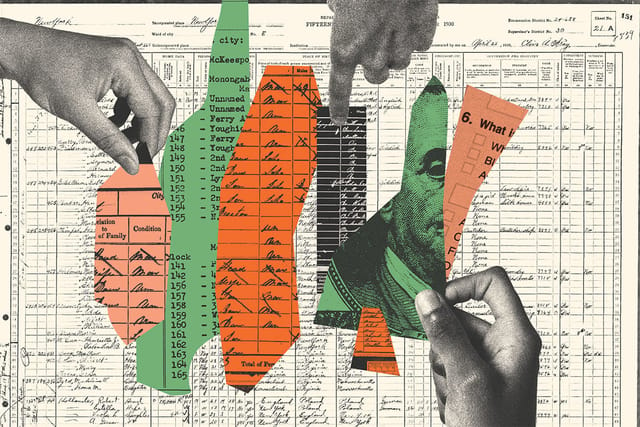
(Illustration: Luna Velez / POGO)
The U.S. government distributes trillions of dollars in federal funds to states, local governments, nonprofit organizations, educational institutions, companies, and individual beneficiaries across more than 300 programs every year. And oftentimes, such dollars are influenced by the Decennial Census (often referred to as the U.S. census), a survey counting all individuals residing in the United States that provides critical information about the nation’s demographics and economy.
Recently, a Project On Government Oversight (POGO) report, Census Matters: Why an Accurate Count is Essential to Funding Our Communities, calculated more than $2.24 trillion were guided by the census for fiscal year 2023. Beyond the trillions in taxpayer dollars at stake, the U.S. Census Bureau is conducting operational testing aimed at improving the accuracy of the census count in 2030. This makes it all the more important to advance tools that build a foundation for an accurate census so states get the funding they deserve. Given the complexity of federal funding allocation, POGO has provided this guidance on how to use our census funding data to further contextualize our Census Matters report.
What does “census-guided” mean exactly?
In POGO’s Census Matters report, a federal program is considered census-guided if it uses census data or census-derived data for a geographic area (such as a state, county, city, etc.) to influence the allocation of funding to those geographic areas. In other words, if the census data or census-derived data is wrong, then it could potentially alter how much of the program’s federal funds go to different communities. This includes
- programs with an allocation formula that uses population and household income data;
- programs that use age and income data collected by the census to determine funding eligibility;
- programs whose application evaluations prioritize certain communities that are defined by the census; and
- programs that target specific geographic regions defined by the census, such as rural and urban areas, which are determined by population thresholds.
How is census data used in certain federal programs?
The census collects information on income, population, age, race, gender, and more. Federal programs use these and other census-derived data points in a wide variety of ways to allocate federal funds.
Programs use census data in four main ways to help guide funding:
- Eligibility criteria — the use of census data to determine which locations or recipients may receive funds from a program.
- Allocation formulas — the use of census data within a program formula to determine the level of funding a location or recipient receives.
- Application evaluations — the use of census data to score or prioritize funding applications.
- Loan interest rates — some federal assistance loan programs use census data in setting the interest rates on the loans they offer or guarantee.
How does the census shape funding for the next ten years?
The U.S. census occurs only once every 10 years, yet its far-reaching impact serves as a baseline for other Census Bureau surveys and studies conducted in the years between. And those surveys also influence federal funding. For example, the Population Estimates Program (PEP) — an annual estimation of the population and number of housing units in the U.S. broken down by state, counties, cities, and towns — uses birth, death, and migration data taken from the census to calculate population change.
Additionally, perhaps a more well-known example is the American Community Survey (ACS), an ongoing survey that releases new data each year tracking socioeconomic, demographic, and housing characteristics of U.S. communities. The ACS estimates are controlled to match the PEP data, which is anchored in the most recent census.
Given how interwoven the census is with other federal data collection efforts, and how census data drives federal funding allocations to states and localities, getting the most accurate count in the census is a critical first step to ensuring proper funding to states and communities over the decade that follows.
Do programs only use data directly from the U.S. census?
No. While many programs use the Decennial Census directly, others use data derived from it, such as the ACS and the PEP. The ACS is an ongoing survey with two data collection cycles, one for annual estimates and one for five-year estimates. The PEP is conducted and updated annually. Programs that use the ACS or PEP to help allocate federal funds are also relying on the census results, even if indirectly. If the census numbers are wrong for a community, then the subsequent results in ACS and PEP will also be incorrect because those databases use the census data as a starting point or foundation.
Can you figure out how much each person in a state is getting and, therefore, how much the state will lose in federal funding for each person missed in the count?
No. The relationship between the U.S. census and federal funding allocations is nuanced and complicated. Not all programs are affected equally by a census miscount. Some programs would see a significant impact on their funding, while others would feel little to none. And the program-by-program impacts of an undercount depend heavily on exactly who is missed and the purpose of the given program.
For example, a significant undercount of a state’s child population would most likely affect funding for programs tied to children’s development, health insurance, and education. However, that undercount would leave programs serving other groups and objectives, such as the elderly, agriculture, and research, largely unaffected. This logic applies more broadly. Any significant miscount is more likely to affect funding programs that serve the miscounted population.
Therefore, evaluating the potential impact of a miscount on a per capita basis is heavily misleading, as it fails to capture how funding effects vary across programs and populations.
Do any programs use full population numbers, and can any be reliably projected by a per capita estimate?
There are a few programs that use straight population numbers from the census. Most notably, a few programs use the Federal Medical Assistance Percentage (FMAP), which relies on a formula that utilizes per capita income data. That income data is adjusted based on census population numbers, which can, in turn, lead to a change in FMAP funding totals, thereby also determining the level of federal matching funds for certain health care programs. If the population numbers change even a little bit, then the per capita income calculation changes and the FMAP percentage changes, thereby changing the rate for the matching funds as well. For such limited cases, you can estimate how much it would cost to miss a person.
Overall, the impact of the census on how much funding a state, county, or community receives can, at best, only be estimated, since the effects vary widely across programs. Our research suggests that the challenge of calculating a more precise estimate stems from incomplete data and the difficulty of tracing spending to the local level once it is expended.
Is there an alternative method to “per capita” that would provide a reliable estimate of the potential funding loss from an undercount?
There is no single best method for accurately estimating the funding impact of a census miscount due to the complexity of how the data is used by agencies.
While a precise prediction of impact is extremely difficult, one could produce rough estimates of the potential impact of an undercount, with certain noted assumptions and clear acknowledgments of the limitations of such estimates. In this vein, POGO would recommend estimating potential funding loss as a proportion of the uncounted population (proportional analysis). Under this approach, a 1% undercount would translate to roughly a 1% loss in census-guided federal funds, offering a straightforward, if conservative, projection of the financial consequences of an undercount.
While individual programs could experience a significant loss in funding, little loss, or none at all from a particular undercount, this approach works on the assumption that, across the hundreds of census-guided programs, the impact would “average out” to a proportional funding loss. This approach only estimates how much of the overall spending a geographic region may gain or lose as a result of a census miscount, and does not account for funding variations within each program. Different programs and counties have varying funding patterns. Without knowing very specific details about who is miscounted, it would be difficult to properly estimate a projection on a more local level.
Users may conduct this kind of proportional analysis using two population parameters: state or county.
- State Parameter Example: In FY 2023, California had a population of 39,242,785 and received $276,501,123,114 in census-guided federal funds. If California’s population increased by 1%, this approach would anticipate a proportional 1% increase in federal funding. In other words, if the population increased to 39,635,213 (+392,428), the state would receive an estimated $279,266,134,345 (+$2,765,011,231) for the fiscal year.
However, the new estimated state total should not be equally divided across counties or programs to determine the change per county or program, as it doesn’t account for their variations. The state total should only be used to represent a high-level estimate of how funding could change.
Proportional analysis is a method that produces a more accurate result than a per capita comparison, but it still has notable limitations. Not all programs respond to population changes equally. Census-guided programs use a variety of funding formulas, some of which include caps, floors, or other variables that affect how a population change translates to a funding change. A 1% change in population does not automatically yield a 1% change in funding across all programs.
Proportional analysis using state population comes with tradeoffs. Data users should be transparent about the limitations of this approach and avoid making claims or drawing conclusions beyond what the methodology supports.
Summary
POGO's census-guided spending data is intended to illustrate the estimated impact of census population counts on federal funding. When using or citing this data, it is important to keep in mind that these are not exact figures. Without comprehensive, program-level data linking every federal dollar to a specific census-derived formula, it is impossible to calculate the precise amount of funding affected by a census miscount without a margin of error.
The data covers census-guided spending only. POGO’s analysis is limited to federal spending that is directly influenced by census data. It should not be applied to all federal spending or interpreted as a comprehensive measure of total federal investment in a state or community.
Fundamentally, reliable and complete government data resources are critical to our work. The accuracy of POGO’s census funding data depends on a complete and accurate census count. Without comprehensive data, tracking exact dollar amounts is impossible — and that is one of the many challenges POGO has told Congress to address.
Related Content