Fact Sheet: Refusing Unlawful Orders
Congress should understand, protect, and improve service members’ duty to refuse unlawful orders.
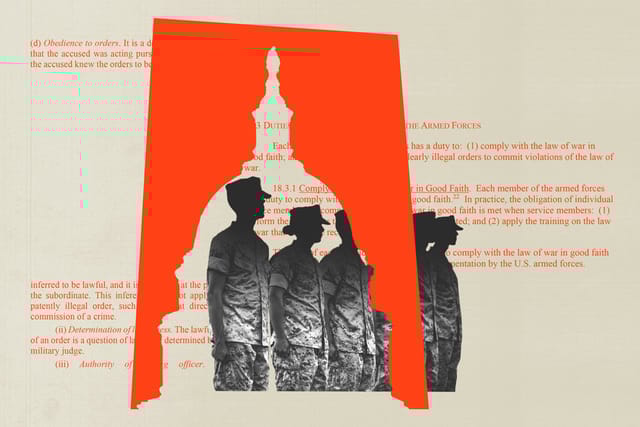
(Illustration: POGO)
The Problem
Americans rely on our service members to refuse unconstitutional or illegal orders, as they are bound by law and oath to do.1 On November 18, 2025, a group of U.S. senators and representatives — all military and intelligence service veterans — participated in a video emphasizing the importance of service members refusing unlawful orders.2 In the weeks following, three important, related events made news: The president said these lawmakers had engaged in sedition, the Department of Defense announced it was investigating one senator for his part in the video, and the Washington Post published an article calling into question the lawfulness of orders in a September 2025 strike on a Venezuelan boat allegedly smuggling drugs.3
Together, these events demonstrate there is more work left to do to ensure service members can fulfill their oaths. They spotlight three key problems that Congress must work to address.
The obligation to refuse illegal orders may be unclear. While the law is unequivocal, it can be complex to explain. This may make it easy for some members of the public, the armed services, or even Congress to believe claims by the president that even encouraging the refusal of unlawful orders is sedition.
Congress continues to cede war powers to the executive. The Constitution gives Congress the power to declare war.4 While Congress delegated some authority to the president under the War Powers Act, it also expressly limited when presidents may use the military unilaterally. Administrations from both parties have violated existing law without consequence, and most recently, Congress has not formally demanded that the Trump administration justify recent strikes, as the law requires.5
Service members may feel unable to refuse orders. In addition to threatening language from the commander in chief, personnel contemplating refusing orders they believe to be illegal know that they face prosecution led by the very chain of command that issued the allegedly illegal orders.6
The Solutions
Members of Congress must know the law around unlawful orders. The obligation to refuse unlawful orders is codified in the Uniform Code of Military Justice, which is part of U.S. legal code, and clarified in the Manual for Courts-Martial:7
- If a crime is committed, obedience to orders is not a defense if those orders are unlawful.8
- The crime of disobedience to orders is specifically defined as “willfully disobeys a lawful command,” and the lawfulness of the order is “determined by the military judge.”9
The Defense Department’s Law of War Manual is more direct: “Each member of the armed services has a duty to: … (2) refuse to comply with clearly illegal orders to commit violations of the law of war.”10 It specifically calls out orders to give no quarter as illegal, and also states that, “orders to fire upon the shipwrecked would be clearly illegal.”11
Congress must enforce the War Powers Act. Congress should either authorize the president to continue military action by passing the required resolution, or it should require that he cease hostilities and impeach him if he refuses.
Congress should improve current laws. We believe the following changes could be made to strengthen protections against unlawful use of the military, and we encourage you to support all of them:
- Pass the bipartisan National Security Powers Act to clarify how military force is authorized.12
- Try refusal-of-orders cases outside the chain of command, as in cases of sexual assault.13
- Pass the OLC Reporting Act to increase transparency of executive branch legal interpretations.14
Contact
Greg Williams, Director, Center for Defense Information, Project On Government Oversight, [email protected]