Coalition Urges Senate: Close U.S. Attorney Vacancy Loopholes
The administration is making an end run around the Senate’s constitutional power to fill U.S. attorney vacancies.
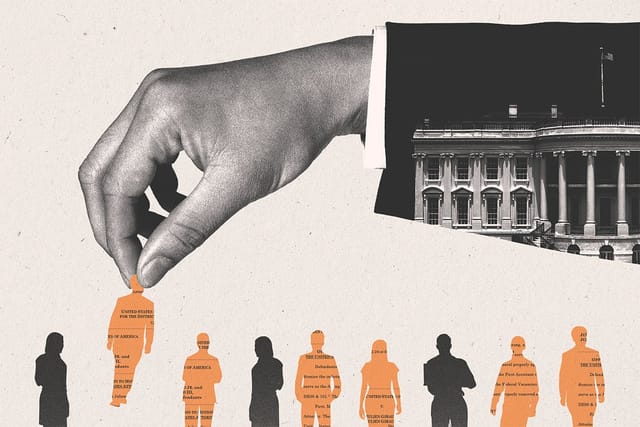
(Illustration: Ren Velez / POGO)
Dear Senator:
The undersigned organizations write to express our deep concern about the administration’s tactics for filling U.S. attorney vacancies and the resulting erosion of the Senate’s advice and consent power. We urge you to pass legislation that would close the loopholes these tactics have exposed and to address this executive branch overreach.
U.S. attorneys must be nominated by the president and confirmed by the Senate. Vacancies in U.S. attorney positions are covered by two laws. The first, 28 U.S. Code § 546, allows the attorney general to appoint an interim U.S. attorney for 120 days, so long as the person is not someone the Senate failed to confirm. Once the time limit expires, the district court for the relevant district may appoint an attorney until the vacancy is filled.1 The second, the Federal Vacancies Reform Act of 1998 (Vacancies Act), sets the rules for who is allowed to perform the functions and duties of a vacant office as an “acting” official and how long they can perform them (210 days).2
President Donald Trump has combined the interim appointment term limit (120 days) and the Vacancies Act term limit (210 days) to install his picks in U.S. attorney vacancies. The administration has also employed a tactic of appointing desired candidates as “special attorneys” whose duties mimic those of a U.S. attorney. The result is an end run around the Senate’s advice and consent power.
As of this writing, the administration has intervened in five U.S. attorney vacancies in ways that threaten the Senate’s power of advice and consent.
- In the District of Nevada, U.S. Attorney General Pam Bondi appointed Sigal Chattah as acting U.S. attorney the day before her interim appointment was set to expire; Nevada senators spoke out against the move.3 Acting U.S. Attorney Chattah’s appointment was challenged by Nevada’s federal public defender’s office; at the end of September, a federal judge ruled that U.S. Attorney Chattah had been unlawfully appointed.4
- In the District of New Mexico, Attorney General Bondi appointed Ryan Ellison as acting U.S. attorney as his interim term ended.5 Shortly before Attorney General Bondi made that appointment,, judges in the district declined to appoint him as the attorney under 28 U.S. Code § 546(d).6 New Mexico senators spoke out against the appointment as an attempt to bypass the Senate or district court.7 In early September, federal public defenders in the state challenged Acting U.S. Attorney Ellison’s appointment.8
- In the Central District of California, Bill Essayli’s interim appointment was due to expire in July; Attorney General Bondi appointed him to serve as acting U.S. attorney as his interim term ended. At the end of August, the federal public defender filed a motion seeking to disqualify him from the position because he lacked Senate confirmation.9
- In the Northern District of New York, Attorney General Bondi named John Sarcone the interim U.S. attorney in March. Just before his term was set to expire in July, district judges declined to appoint him as the U.S. attorney.10 The Department of Justice then named Mr. Sarcone “special attorney to the attorney general” authorized to conduct any kind of legal proceedings which U.S. attorneys are authorized to conduct.11 Special Attorney Sarcone also claims that he had been designated the First Assistant U.S. Attorney for the Northern District of New York, meaning that he is somehow filling both the primary position and its first assistant seat simultaneously.12
- In the District of New Jersey, President Trump tapped Alina Habba to be the interim U.S. attorney in March, and formally nominated her for the position on July 1.13 As then-interim U.S. Attorney Habba’s term came to a close later that month, the district court appointed another attorney to fill the vacancy; Attorney General Bondi removed and later fired that appointee.14 Ms. Habba subsequently announced she was the acting U.S. attorney, and the president withdrew her nomination to comply with the Vacancies Act (a person cannot serve in an acting capacity if they have been nominated for the same role).15 Attorney General Bondi also made Ms. Habba a “special attorney to the attorney general,” and defined her duties as those of the U.S. attorney of New Jersey.16 Defense attorneys in the state filed legal challenges to Ms. Habba’s ability to serve as acting U.S. attorney. And on August 21, a federal district court judge in Pennsylvania ruled in that challenge that Ms. Habba was serving in her role unlawfully and had been since July 1. Specifically, the judge concluded that a provision in the Vacancies Act precluded the administration’s special attorney maneuver.17 The ruling, which has significant implications both for the cases Ms. Habba is prosecuting and for cases challenging whether other acting U.S. attorneys are filling their roles legally, is on hold while the administration appeals.18
Home state senators in Nevada and New Mexico spoke out against the appointments in their states, which means the candidates may not have advanced in the Senate. Employing procedural tricks to avoid formal confirmations and steamrolling senators demonstrates that the president will have his desired U.S. attorneys ― regardless of the Senate.
In addition to eroding the Senate’s advice and consent power, the administration’s overreach impacts everyday Americans living in these states: While the courts hash out the legality of these appointments (all but Special Attorney Sarcone have been challenged), the public’s access to justice is delayed.
Clarifying and strengthening the law governing vacancies would help address these and similar situations in the future. Legislation introduced in previous Congresses, like the Accountability for Acting Officials Act, is a good place to begin to reform the Vacancies Act. That measure would reduce the amount of time acting officials can serve as agency heads, require acting officials to testify before Congress at least once every 60 days, and prevent presidents from appointing acting officials who lack the necessary experience and qualifications to lead an agency. 19
Additional solutions are needed to address specific challenges this administration has surfaced in its efforts to fill U.S. attorney vacancies. We urge Congress to clarify how, if at all, the two statues governing U.S. attorney vacancies can be used in combination. We also urge Congress to limit the attorney general’s power to appoint someone as a “special attorney” simply to enable them to serve as an acting U.S. attorney indefinitely. Last, we ask Congress to prohibit a person from serving in an acting capacity under the Vacancies Act if their nomination has been withdrawn (as in Ms. Habba’s case).
Congress must guard its constitutional duties and resist executive overreach. The separation of powers is critical to the continued functioning of our government. We urge you to push back against efforts to weaken your advice and consent powers.
Signed by:
- Project On Government Oversight
- Alliance for Justice
- American Constitution Society
- Campaign Legal Center
- Citizens for Responsibility and Ethics in Washington (CREW)
- Democracy Defenders Action
- MOVI, Money Out Voters In
- National Voter Corps
- Oregonizers
- People For the American Way
- Public Citizen
- Secure Elections Network
- State Democracy Defenders Action