NDAA Could Help Regulate Prediction Markets with Stronger Language
By strengthening provisions in this year’s NDAA, Congress could curb the risk of government officials insider trading via prediction markets.
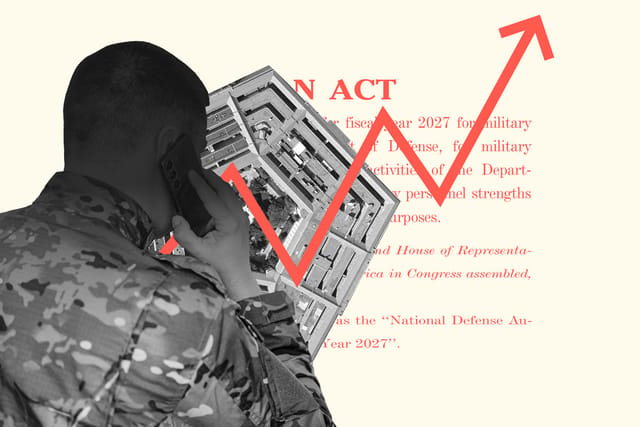
(Photo: Getty Images; Illustration: Leslie Garvey / POGO)
To:
- The Honorable Roger F. Wicker
Chairman
U.S. Senate Committee on Armed Services
Russell Senate Building, Room 228 Washington, DC 20510 - The Honorable Jack Reed
Ranking Member
U.S. Senate Committee on Armed Services
Russell Senate Building, Room 228 Washington, DC 20510
Dear Chairman Wicker, Ranking Member Reed, and members of the Committee:
Over the past year, the Project On Government Oversight (POGO) has been a leading voice proposing reforms to address public interest concerns and the risks of insider trading in government raised by prediction markets.1 As the Senate continues to deliberate the language for the Senate version of the National Defense Authorization Act (NDAA) for fiscal year 2027, POGO commends members of Congress for their concerted efforts to prohibit trading based on material nonpublic information within the military and to bar betting on and profiting off of event contracts related to military matters.
We recognize the national security implications and believe that meaningful enforcement would be key to rooting out the risks posed by prediction markets. The following highlights existing gaps in the current language and recommends improvements that could strengthen the relevant provisions in this year’s NDAA.
Current Gaps
Enforcement depends on determination of whether a trade involves material nonpublic information, not the trade itself. As written, Section 1081 would require any covered transaction that has a value of more than $250 to be reported to the designated agency ethics official. While this provision increases reporting, it still leaves room for insider trading to occur and does not limit trading as aggressively as it should. Prohibition depends on whether the individual traded using material nonpublic information. Covered Department of Defense personnel engaging in trading is not itself considered a violation. Additionally, a violation is subject to the reviewer’s judgment regarding what constitutes material nonpublic information. It isn’t until these two standards, the trade exceeding $250 and trading on material nonpublic information, are met that enforcement is triggered. POGO urges Congress to prohibit any and all trading on prediction markets within the Department of Defense, irrespective of the trade value or whether material nonpublic information was used.
There are no clear penalties for failure to report. The penalties in the current language apply only when someone is found to have violated the prohibition. In other words, when they are discovered to have used material nonpublic information to profit from a trade. The text is not clear about what happens when a covered individual fails to report, so there are currently no obvious consequences for noncompliance.
The penalties themselves are undefined. As written, the Department of Defense would be responsible for prescribing the penalty in the case of a violation of these provisions. However, unclear penalties give the Secretary of Defense arbitrary agency to determine the degree of enforcement. Penalties should be standardized, or at least have a statutory floor.
It is not clear whether financial disclosures to the designated ethics official would be made public. Accountability is possible when there is transparency. The financial disclosure requirements in the statute detailing a covered individual’s trading activity should specify that these disclosures be made public.
An Opportunity to Curb Insider Trading
Stronger provisions regarding prediction markets would not only be timely, but necessary. The need has been illustrated by public reports on the vulnerabilities of military-related markets to insider trading and the recent indictment of Special Forces soldier Gannon Ken Van Dyke, who was charged for allegedly using classified information to make a trade on Polymarket that earned him more than $400,000.2 The government must ensure that classified information can’t be commodified for personal gain. The public deserves a military that always prioritizes national security and is not compromised by opportunities for private profit.
Thank you for the opportunity to submit this information. If you have any questions, please contact Janice Luong at [email protected].
Signed by:
- Janice Luong
Policy Analyst - Virginia Burger
Senior Defense Policy Analyst