Census Matters: How Census Shapes Funding for Rural Communities
In FY 2023, billions of dollars went to census-guided programs for rural communities. A census miscount can influence where billions of dollars go.
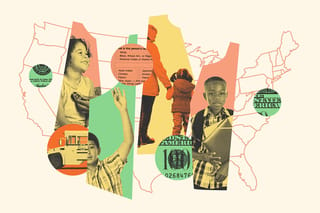
(Illustration: Luna Velez / POGO)
Census Matters is a Project On Government Oversight (POGO) series that tracks the distribution of census-guided federal funding to individual states and that details how the decennial census influences the allocation of those funds across the United States.
In our initial Census Matters report, POGO tracked how 371 federal assistance programs geographically distributed funds to states in fiscal year 2023. Those funds provide significant resources to many communities.1 In this report, POGO examines how census accuracy impacts critical federal funding for rural communities across the U.S.
POGO classified census-guided programs as serving rural communities if the programs require a geographic location that has less than 2,000 housing units or has a population of less than 5,000 people.2 Programs that fall under the rural classification are often interdisciplinary and aim to assist people across the different aspects of rural life such as agricultural issues, health, public safety, housing, and more.
Rural communities often have fewer local resources, greater infrastructure challenges, and higher costs of providing essential public services than more populated regions do. This ranges from improving public transportation infrastructure, maintaining roads and water systems, and improving the education system.
Many people may not realize how influential the census is in determining how much federal money gets allocated to different geographic regions across the country. Census-guided programs serving rural areas often deliver funds directly to individual beneficiaries, communities, or state agencies. Depending on the program, it may use census data such as location, population, household income, age, school districts, and school enrollment to determine state eligibility and distribution.
The deficit or surplus of federal funding a state may receive stemming from inaccurate counts can directly impact the quality of life and access to resources for individuals and families in rural areas. An undercount could mean fewer dollars, thereby fewer resources. An overcount could result in a state receiving more federal funds than its population warrants; for programs with fixed appropriations, this may proportionately reduce the share available to other states.
Rural Communities Remain Hard to Count
The U.S. Census Bureau historically struggles to count rural communities due to their remote geographies, limited access to the internet, and disproportionately high hard-to-count populations.3 Moreover, it requires great effort and resources to conduct outreach and collect data for the census. These challenges mean that rural communities face a high likelihood of being miscounted, and so a higher risk that they may not gain access to critical federal funding.
Trillions of census-guided dollars are allocated for states or directly to beneficiaries every year.4 It is important that the government address the structural barriers to getting an accurate census count in rural areas because the census count influences how 371 programs allocate those federal dollars.
Spending Distribution of Census-Guided Rural Programs
Of the 371 census-guided federal assistance programs operating in fiscal year 2023 that POGO identified, 69 were programs that served rural regions. These programs accounted for approximately $37.91 billion of the $2.24 trillion in total census-guided funding disbursed to all 50 states and Washington, DC, representing 1.69% of the total census-guided funding in FY 2023.
Of the 69 programs, the Very Low to Moderate Income Housing Loans program was the largest rural-serving program, with $8.19 billion having been allocated nationwide in FY 2023. The Rural Electrification Loans and Loan Guarantees program with $6.60 billion, the Universal Service Fund - High Cost program with $4.19 billion, and the Business and Industry Loan program with $2.32 billion were the three next largest census-guided programs with a rural focus.
Rural-serving programs affect many sectors and parts of the community. Larger programs such as those listed above provide resources that go toward housing, electricity, broadband services, and business development. Other census-guided programs for rural communities provide resources for education, food security, agriculture, and more.
In another POGO report, we looked at census-guided programs serving children in the U.S. Unlike those programs, there does not appear to be a clear relationship between the state’s population size, the state’s proportional rural population, and the discretionary funding amount from census-guided programs focused on rural areas. According to the 2020 census, Vermont had the largest population proportion residing in rural areas, followed by Texas, North Carolina, Pennsylvania, and Ohio.5 However, the data indicates that Georgia received the most census-guided dollars from programs with a rural focus, at $2.83 billion; Texas received $2.04 billion; Missouri received $1.85 billion; and California received $1.69 billion.
How Missed Dollars Can Affect Rural Populations
Rural areas tend to have lower local tax revenues, which means fewer dollars are available to reinvest back into their communities for things such as infrastructure, schools, hospitals, and public services. This makes them more dependent on federal funding to address community needs. As a result, an accurate census count is especially critical for rural communities because an undercount could mean less federal support.
POGO found 69 census-guided programs that the federal government funds to provide services that benefit rural communities. The following examples illustrate how the services those federal assistance programs provide affect different aspects of rural living.
Education
Rural education systems are often underfunded and under-resourced, making an accurate census count even more crucial.6 Chronic challenges include student and teacher retention, quality of education, and improving internet access.7 An accurate census count is one of the most, if not the most, direct ways to provide national data so rural schools can demonstrate their needs for federal funding that could alleviate some of these challenges.
In FY 2023, we tracked 8 programs impacting education in rural areas. Of these, Smith-Lever Funding programs are the largest, providing extension services that bring research-based knowledge to agricultural communities. Title I Grants is another program that provides significant funding that would be affected by a census miscount. A census undercount of school-aged children in a community could result in less financial assistance than their actual population qualifies them for since allocation is based largely on the number of children who fall below the poverty thresholds. A census undercount that misses children whose household income falls below the federal poverty level in a district, a risk that’s often higher in rural, hard-to-count areas, can shrink that district’s estimated poverty count and, in turn, the Title I funding it’s entitled to, regardless of actual enrollment. It is worth noting that reported student enrollment affects funding allocation differently per program, so the degree of influence varies.8 Income data and various costs are also factors.9
Census-guided federal dollars address different needs in the academic environment, including ensuring that students are fed, that there is broadband or other access to the internet, and that students who are underserved or below the federal poverty threshold are provided with additional resources.
Broadband Access
Access to the internet is crucial to creating opportunities for rural communities, supporting nearly every aspect of infrastructure and community development. It is used in hospitals, schools, businesses, local government, libraries, to create jobs, and more. Broadband internet in particular is becoming more important. Yet according to the Federal Communications Commission, nearly a quarter of the rural and tribal population lack access to fixed broadband services.10
Of the 69 census-guided programs POGO identified as serving rural regions in FY 2023, we tracked 9 that were broadband programs. And programs that fell under this category tended to be larger or received more money than other categories. Some of the larger programs include the Universal Service Fund - High Cost program, Rural eConnectivity Pilot Program, and Emergency Connectivity Fund Program. Because broadband expansion programs often rely on census population numbers or demographic data to identify and provide resources to unserved or underserved communities, census accuracy influences whether communities qualify for assistance.11
Without improving broadband internet access in rural communities, residents will continue to face inequities in technology, health care, education, business development, and more.
Housing
In rural areas, homeownership rates are higher compared to urban areas, but the median household income tends to be lower.12 Rural housing is also more dispersed across larger geographic areas, with single-family homes being the norm rather than dense, multi-unit developments. When there’s a combination of higher home ownership, less condensed housing, and a lower median household income, it could constrain housing supply. Federal housing programs aim to alleviate the pressure of this constraint by subsidizing housing costs through different programs.
We tracked 15 census-guided housing programs that include a specific rural criterion. The largest of these programs in FY 2023 was the Very Low to Moderate Income Housing Loans. The program offers direct loans to “low- and very-low-income applicants” with interest rates as low as 1% and guaranteed loans for “moderate income households” in eligible rural areas.13 The second largest rural housing program focuses on residents who are renting. The Department of Agriculture’s Rural Renting Assistance Payments program reduces rents paid by eligible tenants in rural areas.14
Energy
In FY 2023, we tracked two census-guided energy-related programs serving rural communities.
The Rural Electrification Loans and Loan Guarantees program and the Rural Energy for America Program (REAP) are two examples of federal programs that support electrical infrastructure in rural communities. Both provide loans for building sustainable energy systems; REAP also offers grants.15
Reliable, sustainable energy infrastructure is essential to rural life. It shapes affordability, business development, job creation, local economic growth, and more. Because rural communities often face higher utility costs, whether due to lower population density, high operational costs, or other factors, federal programs like these help close the equity gap. Additionally, energy costs directly affect the agricultural sector, which drives much of the rural economy.16
Community Efforts in Anticipation of the Next Decennial Census
Census miscounts (depending on the severity) can result in states and communities losing significant federal funding across many programs. Communities, especially those that are historically underserved, could experience financial shortfalls and are most vulnerable to barriers that make it more challenging to maximize federal dollars.
Preparation for a decennial census can begin before the previous census has even been conducted. For instance, the early planning phase for the 2030 census began in 2019. Currently, we are in the second half of census preparation, specifically the Development and Integration Phase, where the Census Bureau continues doing research, collects data from two different test sites, and refines its operational design.17 During this phase, advocates can take part in a public education campaign to promote participation and psychological safety, can form Complete Count Commissions to raise general awareness and encourage residents to respond to the census, and can increase state collaboration with and participation in census partnership programs. Also, states can invest in efforts to avoid a significant miscount by partnering with city leaders, or accounting for census efforts in the state budget.18
Tribal, local, and state governments may also prepare for and participate in census partnership programs like the Local Update of Census Addresses (LUCA) operations. LUCA is an opportunity for tribal, state, and local governments to review and update the Census Bureau’s address list for their geographic area prior to the 2030 census, which may improve the completeness and accuracy of the count. They can verify the accuracy of address lists and make any corrections or identify any missing information, including address additions, deletions, conversions, and spatial updates. LUCA stands out as one of the few opportunities for tribal, local, and state governments to directly improve census accuracy in their jurisdictions on a standardized, nationwide timeline.19
-
POGO used the following sources and methods to calculate the total FY 2023 spending for each rural program and state.
Federal Funds Information for States (FFIS)
The Federal Funds Information for States (FFIS) is an organization that tracks and analyzes more than 90% of federal funds flowing to state and local governments. The organization shared its FY 2023 spending data with POGO on the condition that program-specific spending amounts by state not be published. POGO sourced spending amounts for one program from the FFIS data covering $87.9 million, or about 0.2% of the funding tracked in this report.
Spending data for some federal assistance programs tracked by FFIS is split into sub-programs or activity areas. POGO combined these sub-program spending amounts into single spending totals in each state for each program.
USAspending.gov
The website USAspending.gov is the primary portal to access federal award data, including contracts, grants, direct payments, and loans. POGO sourced spending data for 31 programs from USAspending.gov covering $26.7 billion in spending, or about 70.4% of the funding tracked in this report.
For most programs, POGO used the place of performance for prime awards to calculate spending totals for each state; for five programs, recipient location was used instead of place of performance to identify the state location. These were programs for which the place of performance data did not include a specific state, likely because these programs awarded funds to intermediary entities such as banks or financial institutions that could potentially use the funds for activities beyond the state where they were located. POGO opted to use the state location of the recipients, as it was likely that is where most of these funds were used.
For programs that included loans and loan guarantees, POGO used the face value of those loans as the spending amount since it best represents that amount of assistance being provided. 20
Assistance Listings
The Assistance Listings (previously the Catalog of Federal Domestic Assistance) is an annual government-wide compendium of federal programs, projects, services, and activities that provide assistance or benefits to the American public. POGO sourced FY 2023 spending totals for over $3.6 billion in spending, or about 9.4% of the funding tracked in this report.
POGO estimated state-level spending data for these 25 programs based on the total FY 2023 spending reported for each program and on the observed rate of spending in each state for the 274 census-guided programs for which detailed state spending data was available, which includes many programs that are not focused on rural areas.
Agency Sources
Spending data posted by the agencies overseeing those programs were used to produce state specific allocation totals for many programs. These sources included agency-based award datasets, budget materials, program reports, and more. POGO sourced spending data for 12 programs from agency sources covering $7.5 billion in spending, or about 19.9% of the funding tracked in this report.