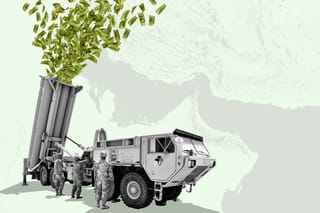
The True Total U.S. Military Budget
There are several ways to calculate the true cost of our military. All add up to at least $1.5 trillion — and that's before the proposed half-trillion-dollar increase.

(Photos: Getty Images; Department of Defense; Illustration: Leslie Garvey / POGO)
Foreword
By Greg Williams
Director, Center for Defense Information at the Project On Government Oversight
For many years, the Center for Defense Information (CDI) at the Project On Government Oversight has offered analyses of how much the United States spends on our military, including amounts that fall outside the budget of the Department of Defense. We do so in order to support CDI’s goal of building a far more effective national security policy at a significantly lower cost — a task that would prove impossible without a comprehensive understanding of what our military costs today.
To illustrate the variety of ways one can quantify military spending in the United States, this report compares the methodologies used by a diverse set of experts and introduces a novel methodology for calculating this spending. While the total cost produced by each method differs from the others, they each support one important conclusion: Military spending in the United States has long been radically underestimated.
It’s reasonable to wonder why a group of budget analysts with, collectively, decades of experience could not agree on a single way to define the United States’ military budget. As this report explains, however, each methodology brings its own benefits and comparing them helps us recognize the right questions to ask when adding up our nation’s military spending. For example:
Beyond the Pentagon, what spending should be included when calculating the cost of our military?
Most readers unfamiliar with the military budget will be surprised to learn that the Pentagon budget does not include all spending on veterans’ benefits, nuclear weapons, or the Coast Guard. And these are just the most obvious examples of programs many would consider “military spending” that fall outside of the Pentagon budget.
Should the cost of peacekeeping factor into military spending? What about interest on loans that financed past wars? Each of the five different methodologies in this report bases its calculations on a slightly different list, inviting readers to ask themselves the important question, “What counts as military spending?”
At what point in the spending approval process should funds be counted as a part of a given year’s budget?
A future-oriented approach, or an approach that focuses on the amount of spending Congress approves, might choose to calculate military spending based on budget authority — essentially, how much a government agency or office is allowed to spend. The methodologies in this report that were developed by Winslow Wheeler; Bill Hartung and Mandy Smithberger; and the National Priorities Project all use budget authorities in their calculations.
However, because some funds are often authorized to be spent over a span of years, it can be difficult to predict when they will actually be spent. An approach aiming to provide unambiguous data about a given year in the past, then, may choose to focus instead on outlays, or what the government actually spent. The methodology developed by this report’s co-authors, Gisela Cernadas and John Bellamy Foster, and the “USAspending” methodology developed by Cernadas, Foster, and co-author David Vine, rely on outlays in their calculations.
From what sources should analysts draw the data they use to calculate spending?
The public has access to different sources of spending data about both authorities and outlays, with each source providing different information — and different levels of granularity.
The executive branch Office of Management and Budget (OMB) outlines the budget authorities for each department in the federal government. OMB provides high-level summaries of where funding is directed within agencies. The Wheeler, Hartung/Smithberger, and National Priorities Project methodologies all use OMB data in their calculations. The Bureau of Economic Analysis (BEA) provides National Income and Product Accounts tables. These datasets, which include more specific information to track outlays, are used in the Cernadas/Foster methodology. Perhaps the most detailed information is that of outlays provided by the website USAspending.gov. The methodology referred to as “USAspending” in this report analyzes nearly 9,000 individual outlay entries to arrive at its estimate.
While the final spending totals identified by these methodologies are strikingly similar, there are important differences. We hope you come away from this report with a better understanding not only of the overall magnitude of military spending in the United States, but also of how to understand spending data, where to find it, and how to make your own decisions about how to interpret it.
Executive Summary
The U.S. government, journalists, and others have long failed to accurately report what taxpayers spend on war and the military. Both Congress and the executive branch report yearly military spending figures that are profoundly incomplete, giving the public only a partial understanding of how much taxpayer money goes to funding armed conflict and the armed forces. Most members of the media, analysts, academics, and others repeat the figures reported by the government, perpetuating the problem.
For several decades, the co-authors of this report and a small number of fellow budget analysts have used multiple accounting methods to show that conventional reporting dramatically underestimates the true size of military spending — often underestimating spending by half.
This report provides accurate estimates of the military budget, reviewing four existing methodologies and introducing a new methodology that draws on publicly accessible government data. Each calculation shows that annual military spending is at a minimum between $1.5 trillion and $1.8 trillion, and between $1.7 trillion and $2.3 trillion when counting interest payments on U.S. government debt attributable to military spending.
The report’s five calculations reflect a consensus about the real size of U.S. spending on war and the armed forces. This comprehensive accounting of the annual military budget is important to allow the public and policymakers to analyze and debate the proper size of military spending, both on its own and in relation to other spending priorities.
Introduction
For fiscal year 2027, President Donald Trump has publicly proposed a $1.5 trillion U.S. military budget.1
“Our Military Budget for the year 2027 should not be $1 Trillion Dollars, but rather $1.5 Trillion,” he wrote on social media when first announcing his plan. Many in the media described the proposal as a “massive” increase on a military budget that, the year before, was widely reported as having reached $1 trillion for the first time.2
While a roughly $500 billion increase would be unprecedented in modern U.S. history, the idea that the military budget only recently hit $1 trillion is incorrect. U.S. military spending has exceeded $1 trillion for many years. It is now almost certainly closer to $2 trillion and may already top $2 trillion. Adding $500 billion (and potentially $200 billion more to fund war in Iran), as the president has proposed, would take the total military budget up to $2 trillion to $3 trillion.3
Whether intentionally or otherwise, Congress, presidents, and the Pentagon have hidden the true size of the U.S. military budget for decades. Journalists, think tank analysts, academics, and other experts have, with rare exceptions, perpetuated the problem by reporting only a portion of true military spending; most are unaware of the costs they’re overlooking. As a result, U.S. taxpayers spend far more on the military and war than most people realize.
On the other hand, a small group of budget analysts has shown the full scale of military spending for several decades. This report builds on their prior work and publicly accessible government data to show that the true total military budget for the last fiscal year (FY 2025) was significantly higher than $1 trillion: It was likely between $1.5 trillion and $1.8 trillion — without counting interest payments on U.S. government debt attributable to military spending.
If, as some do, one includes spending on interest payments — the cost of borrowing the money needed to spend these amounts — the range is between $1.7 trillion and $2.3 trillion.
This report discusses the problems with conventional reporting about military spending and the challenges involved in determining the true total. It then updates calculations for four existing methodologies to show a consensus that military spending already reaches or exceeds $1.5 trillion. Three of the existing calculation techniques rely on Office of Management and Budget (OMB) spending tables and other government budget materials to identify forms of military (or “national security”) spending omitted from official figures. A fourth approach employs data from the U.S. government’s National Income and Product Accounts, which is often used to analyze the U.S. economy as a whole.4
The report then details a new, complementary methodology, described here for the first time, using data from another government source, USAspending.gov. This methodology’s calculation strengthens the conclusions of the older methodologies: It is of a similar magnitude and especially close to the calculations of two methodologies showing that actual military spending is $1.7 trillion to $2 trillion.
People have a right to know how much of their tax money goes to the military and the wars it wages. At an individual level, imagine a financial planner telling you about only 50% to 60% of your actual monthly expenses. Understanding the true amount the country spends on its military is critical to properly analyzing and debating the size of military spending, both on its own and in comparison to other government spending priorities such as affordable housing, public health, and education.
Part I: The Challenges of Calculating Military Spending
Spending Hidden in Other Budgets
Tracking military spending and federal spending of all kinds is extremely difficult. Confusion frequently arises amid presidential budget requests, appropriations and authorization bills in the House of Representatives and Senate, conference bills between the two houses, the difference between department budgets and “budget function” budgets, changes across fiscal years, emergency spending bills, budgets created by continuing resolutions, reconciliation, the rounding of large numbers, and reporting that often confuses these budget functions and practices.
Tracking military spending is even harder than tracking other forms of government spending because the Department of Defense (DOD) is the only major government agency that has never passed an audit.5 The DOD literally cannot keep track of its money, which means that many of its reported spending figures are of dubious accuracy.6
The deeper root of the problem is that Congress pays for the military and wars out of many budgets rather than a single budget. One might think that military spending would be found entirely in a single budget — that is, in the budget of the government agency, the DOD, that includes the branches of the armed services and other military components. To the detriment of transparency and public understanding, military spending is not found entirely in this budget. Instead, hundreds of billions of dollars in military spending are effectively hidden in other government budgets. These sums are, on their own, larger than the budgets of every non-military government agency and every form of government spending other than Social Security, Medicare/Medicaid, and government debt payments.
Recent reporting about a “trillion-dollar military budget” is not wrong in the sense of spending exceeding $1 trillion. What is wrong are the ideas that 1) this is the first time the military budget has exceeded $1 trillion and 2) this sum is a complete accounting of the total military budget.
For decades, we and other budget analysts have warned that most reporting about military spending dramatically underestimates the true size of the budget.7 Repeatedly, analysts have shown total spending is up to twice the levels presented by the government.8 Using different methodologies and employing different definitions of “military spending” (or, in some cases, “national security” spending), these analysts have shown that actual U.S. military spending has exceeded $1 trillion for nearly two decades.9 Unfortunately, few journalists or others have reported these larger, more accurate figures.
The problem with most conventional reporting is that there are hundreds of billions of dollars in military spending outside the DOD’s annual budget appropriated by Congress.10 Even a generally authoritative source of global military spending data, such as the Stockholm International Peace Research Institute (SIPRI), underestimates U.S. spending by overlooking significant sums outside DOD and related budgets. On the one hand, SIPRI rightly attempts to track most forms of military spending regardless of budgetary naming practices. For 2025, SIPRI reported U.S. military spending of $954 billion (a decline from 2024 spending of $997 billion).11
On the other hand, SIPRI excludes the cost of deferred spending on previous military activities, such as veterans’ benefits, other types of military spending, and interest payments helping to fund military spending.12 SIPRI’s approach is effectively an overly narrow understanding of military spending. The exclusion of veterans’ benefits is especially unfortunate and seemingly arbitrary because SIPRI counts “salaries of military and civil personnel and pensions and social services of military personnel.” Veterans’ benefits are, generally speaking, pensions and social services of military personnel who are only different than other military personnel in that they have served in uniform. SIPRI’s methodology thus underestimates military spending for countries, such as the United States, that have fought wars and thus expend significant sums on pensions and social services for veterans (see below for deeper discussion).
In contrast to this and other even narrower definitions of military spending, this report defines military spending as all forms of government expenditures to support all military and paramilitary forces and other government agencies or entities involved in the exercise of military force. The five methodologies represented in the report thus capture forms of military spending outside budgets explicitly identified as “military” or “defense.”13 The following sections discuss the major forms of military spending that are frequently overlooked in conventional reporting and that the five methodologies effectively incorporate.
One might think that defining what is and isn’t “military spending” would be easy. However, as described below, there are many cases in which the definition is ambiguous. These include high-level questions, such as how much of the cost of servicing the national debt should be included, to specific cases, such as whether law enforcement agents wearing helmets and body armor and carrying automatic rifles should be considered “military.” In other cases, such as the Coast Guard, the same units sometimes operate as law enforcement agencies and other times as military forces.14 This report attempts to apply a consistent definition, but the different methodologies each present different challenges to doing so precisely, as described below. How each methodology addresses these challenges is described within the section for each methodology.
Spending on Nuclear Weapons
One immediate source of misperception about the size of U.S. military spending comes from the fact that Congress pays for many of the costs of nuclear weapons — around $33.5 billion in net spending for FY 2025 — in the budget of the Department of Energy. This obscures true spending levels.
Nuclear weapons are controlled and deployed by the military branches and the DOD, not by the Department of Energy. While that department plays some role in overseeing the maintenance of the U.S. nuclear weapons stockpile, putting nuclear weapons spending in the Department of Energy’s budget is like a city putting the costs of its police department’s bullets in the budget of the Department of Public Works rather than in the police budget.15 Any city doing this would rightly be accused of using an accounting gimmick to hide the real size of police spending.
Spending on Retirees and Veterans
A similar problem emerges with hundreds of billions of dollars in spending on retired military personnel and veterans, which is not found in the DOD’s budget. Much, but not all, of this spending instead appears in the budget of the Department of Veterans Affairs, which leads to a misperception that this spending is not military spending. This is inaccurate.
To recruit and maintain armed forces, any government needs to pay troops and offer sufficient long-term benefits (such as pensions, medical care in retirement, and survivor benefits) to encourage people to join and remain in a job that frequently involves dangerous work and the risk of killing and being killed. These forms of deferred compensation are personnel costs that should be counted as military spending. Indeed, military pensions were part of the budget of the War Department until 1849, when Congress transferred the Pension Bureau into the Department of the Interior, later making it a part of an independent Veterans Administration agency.16
Maintaining these forms of spending in another government agency’s budget has effectively hidden the true cost of maintaining a military, of war, and preparations for war. (Spending on veterans has escalated dramatically in recent years because of the vast number of veterans and surviving family members from the post-2001 wars, as well as veterans of wars dating back at least a century earlier.)
Beyond the budget of the Department of Veterans Affairs, Congress has hidden other forms of deferred compensation and long-term benefits in yet other budgets. These include health care, housing, education, income support, and burial benefits, collectively known as the budget function “Veterans Benefits and Services.” While the DOD budget pays for some retirement benefits, the Department of the Treasury pays for tens of billions of dollars to fund pensions for retirees (many of whom are not combat veterans) through the Military Retirement Fund and a similar fund to augment health benefits for Medicare-eligible retirees, the Medicare-Eligible Retiree Health Care Fund.17
The system works like this: the DOD contributes some money to both of these funds out of normal congressional appropriations, and the Treasury Department pays the difference between what the two funds owe and the money the funds have to pay out.18
As longtime budget expert Winslow Wheeler notes, the DOD simply avoids having to pay or budget for nearly $100 billion in spending that is effectively hidden elsewhere in the federal budget.19 The Military Retirement Fund describes its confidence in paying its unfunded future liabilities because of “annual appropriations external to DOD ensuring benefits are paid.”20 The Medicare fund knows it will be fully funded due to a “permanent, indefinite appropriation” from the Treasury Department in place since FY 2001.21
This is like a young person living a wealthy lifestyle that exceeds their income because their wealthy parents pay for almost 10% more in additional annual spending. In this case, DOD’s secretary simply “directs the Secretary of Treasury to make the payments” at the start of each fiscal year, and the Treasury does it.22
The Treasury pays yet more of the DOD’s costs in the form of benefits some retirees receive as both retirees and disabled veterans. These costs are covered in part by the DOD and partly by the Department of Veterans Affairs, with Treasury covering the remainder. The Treasury Department has been paying these unfunded liabilities since Congress changed the law in fiscal year 2005.23
The DOD’s own Board of Actuaries, which oversees the military’s retirement funds, has objected to this policy because it provides the DOD with no incentive to constrain costs, given that it knows more of its future retirement liabilities will be covered in part by another part of the federal government — and thus taxpayers.24 The Board has written that:
Burying such information as an obligation of the general Treasury is misleading and leaves the door open to unrestricted enhancements because DOD has no incentive to hold down retirement benefit costs. The Board recommends that all future legislation require DOD to pay the full normal costs of all the benefits it promises and pay any past service costs associated with benefit increases.25
Spending like this is also known as “mandatory” spending because it is mandated by law. The Board of Actuaries shows how such mandatory spending can effectively hide military spending that should appear in the DOD’s budget, while doing nothing to incentivize cost savings.26
Other Hidden Spending
Other large sums of military spending, running into the tens of billions of dollars, are likewise hidden in the budgets of the Department of State, the Department of Homeland Security, and other agencies. Together, these budgeting practices obscure the real size of the military budget and the public’s ability to understand the relative and absolute scale of taxpayer money going to the military.
Interest Payments
Another form of spending hidden from the public appears in the form of interest payments on debt the U.S. government has assumed to pay for military functions and war (as well as other forms of government spending). Since 2001, in particular, the U.S. government has paid for wars in Afghanistan, Iraq, and far beyond by taking on debt rather than by increasing taxes as the government generally did in most conflicts dating to independence. For this reason, some refer to the post-2001 wars as “credit card wars.”27
Using debt to finance the conflicts has become another way to hide wars’ true costs.28 Non-military government spending also contributes to the national debt — hence when comparing military and non-military forms of spending, one must account for proportional shares of interest payments on both sides.
A small group of budget experts has tackled the challenges of finding these hidden forms of spending and identifying the true cost of the U.S. military. In the following sections, this report employs four existing methodologies developed by the co-authors and others to calculate actual spending levels for the most recent full fiscal year (FY 2025). The report concludes by detailing a new methodology, which produces a new estimate that solidifies a consensus about the true total of U.S. military spending.
Part II: Established Methodologies for Calculating Military Spending
Wheeler Methodology
Pentagon budget expert Winslow Wheeler has provided comprehensive spending calculations for years.29 Wheeler’s methodology captures spending in the DOD as well as in the Departments of Energy, Veterans Affairs, State, and Homeland Security, among other agencies.30
Funding
Wheeler’s methodology seeks to calculate the total cost of “national security” spending. Because this report seeks to allow a direct like-for-like, apples-to-apples comparison between the five methodologies, the report alters Wheeler’s and other methodologies by removing forms of spending that are not military in nature and instead are understood as broader national security expenditures. In Wheeler’s methodology, the report only counts military parts of the “International Affairs” budget. Including the entirety of the International Affairs budget would add another $43 billion.31
In accordance with Wheeler’s approach to include supplementary spending outside annual spending bills, he adds the cost of DOD and Homeland Security spending in Trump’s 2025 budget reconciliation bill.32 The bill included more than $156 billion in Pentagon spending available over five years, as well as $191 billion over the same period for the Department of Homeland Security, including Immigration and Customs Enforcement (ICE), which has increasingly acted like a domestic military force.33
Types of Spending
Wheeler’s methodology is pathbreaking in identifying forms of “mandatory” military spending buried deep in the federal budget. This includes the mandatory spending on retirement benefits, discussed above, that are paid for in part by the U.S. Treasury rather than by the DOD. This spending is entirely off the Pentagon’s books, with the Treasury effectively paying some of the military’s bills. These forms of spending are almost always overlooked in government and media reports. “As DOD-unique spending, they should be displayed as part of the DOD budget, but are not,” Wheeler explains.34 Notably, Wheeler has historically subtracted interest earned by the government in these retirement funds, which lowers overall military retirement costs for taxpayers.35
Wheeler’s methodology also adds the proportionate share of the costs of interest payments on the national debt attributable to military spending. This report provides figures with and without interest payments.
Results
Wheeler’s methodology yields total spending of $1.728 trillion ($2.004 trillion if one includes interest payments).36 The lower figure is nearly 75% above the $1 trillion mark.
Hartung/Smithberger Methodology
William Hartung and Mandy Smithberger are Pentagon budget experts who, separately and independently, have employed a methodology similar to Wheeler’s since at least 2016.37
Funding
In 2019, the two identified “at least 10 separate pots of money” — beyond the Pentagon budget alone — “dedicated to fighting wars, preparing for yet more wars, and dealing with the consequences of wars already fought.”38 Their methodology thus captures spending in the DOD and Departments of Energy, Veterans Affairs, State, Homeland Security, and others.39
Hartung and Smithberger call their calculation the “National Security State Budget,” meaning that they estimate costs beyond those strictly military in nature. As with Wheeler’s methodology, this report alters the Hartung and Smithberger methodology slightly to ensure that each of the report’s methodologies focuses on military spending, thus allowing direct comparison. Here this means again counting only military spending in the International Affairs budget and removing the cost of Federal Emergency Management Agency (FEMA) funding in the Department of Homeland Security budget.
Types of Spending
Like Wheeler, Hartung and Smithberger also include mandatory forms of spending and money from “emergency” spending bills, which some analysts tend to ignore in reporting military spending. For FY 2025, the latter means including Pentagon and Department of Homeland Security spending in Trump’s reconciliation bill.
Results
Hartung and Smithberger’s adjusted methodology yields total spending of $1.766 trillion ($2.049 trillion with interest spending included). This is roughly $40 billion (or 2.3%) higher than the estimate produced by the Wheeler approach, which is unsurprisingly close given the similarities between the methodologies.
National Priorities Project Methodology
Budget analysts connected to the National Priorities Project and its parent organization, the Institute for Policy Studies, have calculated the full costs of military spending for more than two decades.
Funding
Their most recent comprehensive analysis takes a slightly different approach compared to Wheeler, Hartung, and Smithberger in calculating the full cost of “militarism in the federal discretionary budget.” Authors Lindsay Koshgarian, Alliyah Lusuegro, and Ashik Siddique define militarism in the budget as “militarized programs that use violence or the threat of violence or imprisonment, including war and weapons, law enforcement and mass incarceration, and detention and deportation.”40 This means including the costs of “the military and war, so-called ‘homeland security,’ including border and immigration enforcement, federal law enforcement, and the downstream effects of militarism — namely a sprawling, if necessary, apparatus to care for U.S. military veterans.”41
In practice, the methodology overlaps significantly with others, differing in part by including the costs of federal law enforcement and excluding FEMA disaster relief costs. 42
Types of Spending
Because the authors focus on discretionary forms of spending controlled by Congress, the calculation notably excludes mandatory forms of spending and the costs of interest payments on the national debt. The authors focused on discretionary spending alone to call attention to the relative paucity of discretionary spending Congress directs to non-military agencies.
Because reconciliation spending is a form of spending made at the discretion of Congress (a fact obscured when Congress refers to it as “mandatory”), this report once more adds the full cost of Trump’s reconciliation bill. This adds around $12.6 billion in federal law enforcement spending in addition to the spending included in the Wheeler methodology and the Hartung and Smithberger methodology.43
Results
If the authors had included mandatory forms of spending in their methodology, their total would be closer to that of the other methodologies. As the table below shows, the exclusion of mandatory spending on veterans, for example, reduces these costs by more than half from $392.2 billion to $130.0 billion in FY 2025. On the other hand, the inclusion of federal law enforcement activities adds a relatively small sum of roughly $31.4 billion.
In sum, this methodology’s total is still nearly 50% higher than $1 trillion but smaller than other methodologies because of its exclusive focus on discretionary spending: $1.477 trillion ($1.713 trillion with interest spending, which the authors do not include in their original methodology).
Cernadas and Foster Methodology
Gisela Cernadas and John Bellamy Foster offer a different methodology, one based primarily on spending data in the U.S. National Income and Product Accounts (NIPA) rather than data provided by the OMB, which is the basis for most other methodologies.44
Funding
Like other methodologies, Cernadas and Foster also identify forms of military spending ignored by official definitions of “defense spending,” including military spending in space and in grants to other governments. The two note that they have improved on prior NIPA-based calculations by “adopting more conservative assumptions”: specifically, they attribute lower percentages “to the military in federal space expenditures and in grants to foreign countries … in accord with widely accepted mainstream assumptions.” They also account for the costs of military medical insurance previously overlooked in Foster’s earlier work.45
Data Source
Cernadas and Foster’s use of NIPA data (produced by the U.S. Department of Commerce’s Bureau of Economic Analysis) builds on the novel work of Jurgen M. Brauer and a later article by Foster, Hannah Holleman, and Robert W. McChesney.46 Cernadas and Foster note that NIPA data is a more reliable source of spending data than OMB figures, given that NIPA is a foundation for analysis of the U.S. economy as “the most complete and definitive source on U.S. national income and expenditures as a whole.”47 NIPA data is, they write, a “consistent, statistically conservative” methodology for measuring true military spending.48
Results
Cernadas and Foster’s methodology yields a total of $1.494 trillion in spending without interest spending, which is almost exactly equal to the National Priorities Project estimate ($1.477 trillion). The methodology is distinctive in attributing a significantly higher percentage of interest payments on the national debt to military spending: 70.20% for 2022 and 75.97% when applying the same technique for 2025, which produces a sum of $737.4 billion.49 This yields the highest estimate of military spending for FY 2025 when accounting for interest payments: $2.284 trillion.
Part III: A New Methodology for Calculating Military Spending
The USAspending.gov Methodology
This report builds on the methodologies above to offer a complementary methodology based on different publicly accessible government data. The figures are available for journalists and others to see (and download) on a website run by the Department of the Treasury, USAspending.gov, thanks to a 2006 law requiring the government “to give the American public access to information on how their tax dollars are being spent.”50
The granularity of USAspending.gov data allows for the identification of military spending well beyond the DOD budget alone. This report identifies FY 2025 military spending in 15 other government agencies and entities, plus two more agencies where military spending has been found previously but which produced no spending in FY 2025. The following table identifies the 18 total government agencies and entities and the total amounts spent for military purposes (less funds received, known as “offsetting collections,” as described below).51
Type of Spending
Budget Outlays, Not Budget Authority
The USAspending.gov methodology differs from most others in using “budget outlay” figures reported by USAspending.gov rather than “budget authority” figures (Cernadas and Foster’s methodology also reflects outlays).52 Budget outlays are government payments actually made in a given period, while budget authority refers to the authority to spend money that Congress gives to a government agency in a given fiscal year.53 In other words, focusing on budget outlays allows one to identify what the U.S. government actually spent on the military that year.
Focusing on budget outlays is more appropriate when using USAspending.gov data because the data comes directly from reports government agencies are required to submit to the U.S. Treasury tracking actual financial transactions.54 In other words, USAspending.gov allows one to look directly at spending receipts and data summing receipts (by agency and budget function).
Because some government agencies earn money through user fees, interest earned on trust funds, and other means, the USAspending.gov methodology subtracts “offsetting collections” from outlays to arrive at total net budget outlays. 55 This allows this methodology to answer the question of the net total amount the U.S. government actually spent on its military forces last fiscal year.56
Funding
DOD: $1.3 Trillion in Military Spendings
USAspending.gov data indicates that the DOD spent considerably more in FY 2025 than is reported in the media: $1.273 trillion. This budget includes spending for the armed forces and other parts of the massive Pentagon bureaucracy, including all the weapons, troops' salaries, and some — but not all — benefits, military construction, fuel, maintenance, operational expenses, and much more. This already shows that military spending is at least 27% above the $1 trillion mark, with considerably more military spending found in other agencies.
To start, the DOD substantially controls $181 million in global health program funds officially appropriated to the Department of State. While these programs may appear to be purely non-military in nature, a range of ostensibly “humanitarian” programs have military functions by assisting the military in gaining access to and maintaining presence and intelligence gathering around the world.57 The DOD similarly controls another $15.5 million in international economic support funds appropriated to the president through the U.S. Agency for International Development.58 Within and beyond the United States, the Department of Transportation spent around $2.6 million to support maritime Ready Reserve Force (part of the National Defense Reserve Fleet), Cable Security Fleet, and highways spending controlled by the DOD.
Together these sums add almost $200 million in spending beyond the DOD’s official budget. The State Department also expended another $281 million to support military peacekeeper operations. Far larger forms of military spending are found in other agencies, beginning with the Department of Energy.
Department of Energy: $33.5 Billion in Nuclear Weapons Spending
As discussed at the beginning of this report, the most obvious other form of military spending comes in the Department of Energy’s budget, because that’s where the government effectively hides the costs of maintaining and building nuclear weapons. The DOD controls these weapons and their costs should properly be part of its budget. Another $43.7 million appears in the budget of another independent federal agency whose budget should be part of the DOD, the Defense Nuclear Facilities Safety Board, which oversees safety at nuclear weapons facilities. The Army Corps of Engineers, which has both civilian and military functions, spent $260 million cleaning up facilities related to the nuclear weapons complex. Total nuclear weapons spending reaches $33.5 billion after subtracting around $6 billion in “offsetting receipts.”
Department of Homeland Security: $16.8 billion in USCG, WMD, Cyber, Other Spending
U.S. Coast Guard spending is found not in the DOD’s budget but instead in that of the Department of Homeland Security (DHS). This hides spending for an entire branch of the U.S. military. While DHS controls the Coast Guard during peacetime and while it plays some civilian functions, such as improving boat safety and oil spill recovery, the Guard is one of the armed forces and is controlled by the Pentagon during wartime. The vast majority of its budget should be considered military spending. This report does so, adding nearly $14 billion (excluding civilian Coast Guard activities). Additional spending in the DHS budget for programs to counter weapons of mass destruction, radiological preparedness, cybersecurity, and other forms of military spending add around $3 billion.59
The methodologies above, by contrast, consider all or nearly all of the DHS budget to be a form of military or “national security” spending because of DHS’s declared role of protecting the “homeland.” There are good reasons to do so, especially given the increasingly militarized nature of ICE and Border Patrol. These agencies and much of DHS clearly blur the line between police and military forces. However, this methodology does not include the entire DHS budget in its calculation given the ambiguous nature of many DHS programs (which also include domestic disaster response). Including the entire DHS budget would add almost $300 billion more, including reconciliation spending, to the total.60
For similar reasons, and unlike some other methodologies, this report conservatively excludes billions of dollars in FBI salaries and expenses found in the Department of Justice budget. While the FBI performs some military functions, the agency is largely focused on domestic law enforcement. Some consider all police forces to be a type of military force and would thus potentially include tens of billions of dollars in spending on police forces at the national, state, and local levels.
Veterans Benefits: $393.3 Billion in Added Personnel Spending
Taxpayers also spend significant sums to support the U.S. military in the form of the Department of Veterans Affairs and related budgets. The USAspending.gov methodology includes this spending for the same reason other methodologies do: These forms of deferred compensation for troops and other military employees are personnel costs that must be counted as military spending. Simply put, supporting veteran s is part of the cost of running a military.
Funding for the Department of Veterans Affairs alone adds another $389.8 billion to the USAspending.gov methodology total. The Department of Labor’s budget further conceals $3.3 billion in military spending that helps train and support veterans, as well as veterans of the nuclear weapons industry sickened by radiation. The Department of Justice’s budget does much the same, hiding a total of $385.1 million in spending for people exposed to and harmed by nuclear weapons testing radiation and payments for claims related to the U.S. war in Vietnam.61
The American Battle Monuments Commission provides a different kind of benefit for veterans in operating military cemeteries and monuments worldwide, with spending totaling $103.5 million in FY 2025. The veterans benefits system also includes spending for the Armed Forces Retirement Home ($137.5 million) and U.S. Court of Appeals for Veterans Claims ($49.7 million, plus $958,374 spent by the U.S. Chemical Safety Board to support the court). The Social Security Administration’s “Special Benefits for Certain World War II Veterans” program adds a small sum ($260,504). Collectively these entities add $291.9 million. In total, U.S. taxpayers spent $390.5 billion on veterans across seven separate agencies in FY 2025.62
Results
Total Spending of $1.718 Trillion
All of the above forms of spending combined produce a total of $1.718 trillion ($1.930 trillion with interest expenditures).63 This again shows that real military spending is almost 75% higher than the $1 trillion frequently cited. The calculation is also within 2.8% of the Wheeler and Hartung and Smithberger estimates. The next section notes other forms of spending that are not included in this calculation but that one could reasonably add.
Other Spending Not Added
Actual military spending is likely higher than the $1.718 trillion ($1.930 trillion with interest) the USAspending.gov methodology indicates because of additional spending for military purposes buried in budgets for NASA ($24.7 billion in outlays less offsetting receipts) and other agencies not included here.64 NASA space research entails considerable work of a military nature, although there is little clarity on how much of the NASA budget has military functions. The estimate used by Cernadas and Foster suggests that 40% of space expenditures and consumption are focused on the military.65 This would add another $9.9 billion to the USAspending.gov methodology total.
Other methodologies include the entire Department of Homeland Security budget given its declared mission to protect the “homeland” (as discussed above). This would add either $216.9 billion or $292.4 billion to the total depending on whether one includes FEMA spending or not.66 The Department of State’s budget also likely includes forms of spending on the U.S. and foreign militaries not included here. Loan guarantees for the Israeli government are a form of military aid and appear in the USAID budget. There is likely additional spending related to nuclear weapons in the budgets of the Department of Energy, the Nuclear Regulatory Commission, and the Nuclear Waste Technical Review Board.
While the DOD budget contains classified levels of funding for the CIA, National Security Agency, and other intelligence gathering agencies, the government may hide other intelligence funding in other budgets that are not captured in this calculation.67 The calculations also almost surely omit some forms of military spending given the lack of transparency in the federal budget and systemic military accounting problems, among other challenges.
Possible Data Limitations
The Government Accountability Office (GAO) and Congressional Research Service (CRS) have pointed to some data quality problems with USAspending.gov data. Most of the problems identified, however, appear to involve inaccuracies with specific contracts and subcontracts, the location where contracts are awarded, COVID-19 funding, and incomplete spending data due to some government agencies failing to submit data. That the site relies on data reported by government agencies is another reason to be cautious about DOD spending figures in particular, given that the agency is the only one in the federal government never to pass a financial audit.68 Still, the GAO calls the site “the official source of federal spending information.” CRS says the site remains “useful” while suggesting caution given the presence of some incomplete or inaccurate data.69
Despite these potential limitations, which could mean USAspending.gov’s data is either an underestimate or overestimate, there are reasons to be confident in the methodology’s calculations. Above all, the calculations are similar in magnitude to those of the other methodologies documented here. The $1.718 trillion total is around 3% lower than the Wheeler and Hartung and Smithberger methodologies and about 14% higher than the National Priorities Project (which intentionally excludes mandatory spending) and Cernadas and Foster methods.
Conclusion
This report shows that U.S. taxpayer spending on war and the military is far greater than is often reported in the media and by members of Congress, the military, and others. Longstanding congressional budgeting practices have hidden the true size of spending. Journalists and other observers have almost always tended to repeat congressional figures that exclude significant forms of military spending. These exclusions mean that commonly cited figures are many hundreds of billions of dollars, and perhaps more than one trillion dollars, lower than the true total.
What does it mean that the true total military budget is hundreds of billions of dollars more than the “trillion dollar military budget” and similar sums commonly reported? What does it mean that Trump’s proposed $1.5 trillion budget is a sum the country is already spending?
One trillion dollars and even hundreds of billions of dollars are sums so large that they’re incomprehensible for most. The sums are so large one can lose perspective on their significance. Note that the true total military budget is around twice the size of all the money Congress appropriates (i.e., discretionary spending) for all non-military needs combined.70
That the government has been misleading the public and effectively hiding hundreds of billions of dollars in military spending is troubling enough. Imagine the public reaction if news broke that the government was spending nearly twice as much as the government said on public housing, or programs to combat hunger, or Medicaid.
Unfortunately, there remains ambiguity about the full scale of military spending given the poor state of Pentagon accounting practices, including its inability to pass a financial audit. Members of the public and members of Congress need a full accounting of the military budget to analyze, discuss, and debate the proper size of military spending both on its own and in relation to other non-military funding priorities.
To provide accurate spending figures, Congress should reform its budgeting practices and provide a true total military budget that combines all forms of military and war spending in one place and one true total figure. Congress also should stop appropriating, and thus hiding, money for the military in other agencies’ budgets. Until Congress begins reporting accurate numbers, members of the media and other analysts should stop repeating incomplete congressional spending data and tell the public what the country is really spending on the military and war.
Editor’s note: Funding figures for the DOD’s global health programs and a related statistic were originally inaccurate on page 25 of the report but have since been updated.