Exquisite Defense Fails in Practice
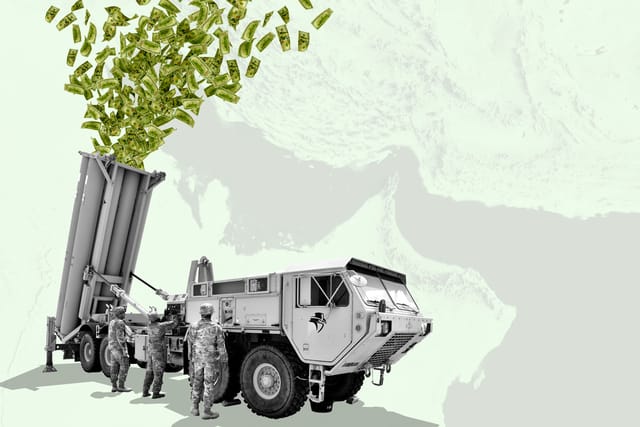
(Photos: Getty Images; Department of Defense; Illustration: Leslie Garvey / POGO)
Until Operation Epic Fury, post-Vietnam War U.S. defensive weapons systems had remained untested in combat against a major adversary. The Global War on Terror focused U.S. strategy and shaped procurement to fight counterinsurgent and tactically proficient adversaries, but it never forced the Pentagon to face off against a peer or near-peer adversary.
Instead, the capabilities of militaries like Iran’s were always addressed in hypothetical scenarios, with the U.S response shaped by wargames and strategic planning. The complex, expensive, and low-density weapons designed to defend against these hypothetical adversaries were touted by defense manufacturers as the best air defense taxpayer money could buy.
Testing has shown some of the limits of these “exquisite” weapons systems. But until Operation Epic Fury, weapons manufacturers’ claims remained unproven in combat against a near-peer adversary. Only now that we are using these systems on the battlefield can we fully assess their capabilities and costs. And only now do we have proof that the Department of Defense has spent billions procuring systems that are failing to perform at the necessary level.
-
There’s a term for the complex, expensive weapons that have been favored by Pentagon procurers and developers since the 1970s: “exquisite.” Over the last two decades, “exquisite” has become shorthand to describe pricey, sophisticated, and often minimally procured systems. Typically, the term has a somewhat negative connotation. The idea that the Pentagon’s focus on expensive, complicated weapons systems is mismatched against the realities of modern war is not new.
The first notable Department of Defense usage came about 15 years ago from former Secretary of Defense Robert Gates, who promoted the acquisition of affordable systems as a shift away from the focus on “exquisite” platforms. Within a few years, “exquisite” was the standard, critical descriptor for the Pentagon’s post-Vietnam procurement trends. In 2014, Thomas X. Hammes, a retired Marine Corps colonel, pitted “exquisite” systems against “small, many, smart” ones.
“The Pentagon needs to rethink the exquisitely capable but extremely expensive weapons procurement programs it is pursuing,” he wrote. “[T]he United States needs to think hard about the shift from exquisite and very few to cheap and very many.”
These critiques didn’t go unheard: Hammes’ commentary ran as senior Pentagon officials were pushing what they referred to as the “third offset strategy.” This strategy focused on expanding the military-technical advantage of the United States.
More than a decade later, criticism of exquisite systems and discussions of their fallibility in modern war have only increased. The Pentagon’s third offset strategy, however, remains ill-defined and poorly actioned.
Some of the failures that have been the most clearly highlighted by Operation Epic Fury are those in our defensive interceptor systems, like the THAAD and Patriot systems. These systems are complex, expensive, and (if we trust the reporting) failing to perform in modern war while remaining a major financial expense for the American taxpayers.
As this year’s National Defense Authorization Act (NDAA) and defense budget move through the legislative process, Congress needs to take a critical look at the performance of systems like these to ensure taxpayer money is not being spent on expensive, exquisite programs that fail to meet the requirements of modern war. It is critical that lawmakers understand the key points of what these systems promised to deliver, what they cost, and how they actually perform.
Operation Epic Fury
Despite limited statements from the government, Operation Epic Fury has been documented in open-source reporting since the start. While there are still gaps in the public understanding of how the U.S. military is performing, there is enough information out there to start making some assessments, especially on how the U.S. air defense systems are performing against Iranian drones.
Recognizing that there are multiple components and levels to air defense, I’d propose we focus on two systems procured and developed by the Pentagon that include some of the most exquisite of those components. The Patriot Air and Missile Defense System (Patriot) and the Terminal High Altitude Area Defense (THAAD) use radars to detect and target incoming munitions with defensive interceptor missiles.
The Promises: Outpacing the Threat Through 2048
The Patriot system is a crown jewel of defense prime marketing. RTX, Raytheon’s rebranded umbrella company, is the primary developer and manufacturer of the Patriot system. On its website, RTX claims that “Patriot is the only combat-proven ground-based air and missile defense capability in the world able to defend against … the full spectrum of air-breathing threats.” The system’s anti-missile capabilities are espoused repeatedly, citing “its effectiveness against advanced aerial threats and massive complex raid attacks.” At the conclusion of its description of the system, RTX says that “Global Patriot has a defined growth path that will ensure the system continues outpacing the threat through 2048 and beyond.”
Lockheed Martin manufactures today’s PAC-3 MSE interceptor, the most advanced interceptor missile variant designed to operate within the Patriot system, and makes equally significant claims about the interceptor’s specific capabilities. On its website, Lockheed says that “the PAC-3 MSE is an industry-leading, hit-to-kill missile interceptor designed to counter advanced threats including ballistic missiles, cruise missiles, hypersonics and aircraft.” Lockheed Martin Vice President of Integrated Air and Missile Defense Jason Reynolds recently said that “PAC-3 MSE is the most capable air defense weapon on the planet.”
Lockheed has heaped similar praise on THAAD. The first THAAD battery was activated in 2008, and throughout the 2010s, the manufacturers used marketing language highlighting high rates of effectiveness in testing, which became its public identity. From 2007 to 2015, the system intercepted twelve out of twelve ballistic missile targets across 10 flight tests, further cementing Lockheed Martin’s ongoing claim of a “100% success rate,” which became the standard talking point for foreign military sales.
On the battlefield, however, these systems have struggled to live up to the hype.
Operational Failures: Performance within the Realities of Modern Combat
When looking at the performance of these weapons systems, the first area of focus should be operational failures. The list of problems is significant, but we’ll focus specifically on failures to anticipate the realistic threats and sensor losses that lead to system inoperability.
Both Patriot and THAAD were developed to handle a very narrow threat picture. Today, the Patriot system is deployed to defend against a much wider assortment of aerial threats. But when the system was first brought online, it was designed to defend against aircraft, with missiles eventually being added to its portfolio through Gulf War-era software updates.
The original capabilities of THAAD were calibrated to targets flying well above the altitude of conventional aircraft. Unfortunately, the threat the Iranian military presents is fundamentally different, with one-way attack drones like the Shahed dominating the battlespace, from a maximum flight altitude of around 5,000 meters, reshaping the necessary considerations for modern war.
The limitations of these exquisite systems became immediately evident when Iran’s opening salvos included a combination of Shahed drones, cruise missiles, and ballistic missiles. Iran’s approach was purpose-built, with relatively simple, inexpensive weapons sitting at the center of its strategy to dismantle and elude these expensive, sophisticated systems. The strategy has seen some successes, as THAAD and the Patriot system have been overwhelmed by threats within their narrow targeting range.
Based on what can be surmised about the weapons in the region and their capabilities, it appears Iran’s Shahed drones were deployed in “swarms,” similar to how the Russian-procured variants have performed in Ukraine, at numbers greater than those our air defense systems could target, overwhelming them with volume. The number of drones deployed rapidly outpaced the ability of the networked defense systems to feasibly counter them in real time. Following these swarms, the drones enabled the larger impact and higher-flying cruise and ballistic missiles to sail through the defensive systems to strike previously protected targets.
While the volume of Shahed drones was a key factor in Iran’s relative success, it’s not the most significant problem with these systems. The real problem is that Patriot systems and THAAD can’t even detect these drones. The Patriot AN/MPQ-65 radar was designed to detect ballistic missiles and high-altitude targets. The limits of its capabilities when up against the threat of low-flying drones were already known. In a January 2024 incident in Jordan, at least one low flying drone like the Iranian Shahed killed multiple Americans. In after action reports, it was noted that personnel on the base saw an unknown object, thought to be birds rather than a drone on their screens, suggesting these low-flying munitions were able exploit gaps in U.S. air defense networks.
In the actual moment when these systems needed to succeed, the enemy was able to exploit their known weaknesses with cheap drones.
The vulnerability created by the air defense systems’ inability to detect low-flying drones was documented and identified in subsequent investigations. This was a known gap prior to Operation Epic Fury, and yet there is no public evidence the military made any level of concerted efforts to mitigate it, either through the deployment of supplemental systems or in adjustments to the existing ones.
Iran has been able to exploit this gap and target the systems themselves to further degrade the U.S. air defense capabilities against ballistic missiles.
As a case in point, during the opening days of the conflict, Iranian attacks led to a THAAD being brought completely offline. Using overwhelming swarms of drones and missiles, Iran successfully destroyed an AN/TPY-2 radar at Muwaffaq Salti Air Base in Jordan, ostensibly dismantling the entire air defense system it supported. Without its AN/TPY-2 radar, a THAAD battery cannot independently search for or track targets. As a result, any forces or infrastructure that were previously protected from missile attack by the THAAD were now left vulnerable to Iranian strikes.
Another likely example of the failures of Patriot and THAAD systems came in the Shahed attack on a Kuwaiti operations center on March 1, 2026 — to date, the deadliest incident for Americans since Operation Epic Fury began. Survivors told media outlets that the Pentagon’s characterization of the drone hit as a one-off anomaly that bypassed capable defenses was inaccurate. Instead, they described their unit as “unprepared to provide any defense.”
The location that was struck, Port Shuaiba, is a major facility that plays a crucial role in Gulf shipping operations. While our military footprint there is small relative to other bases in the Middle East, the military has been active at Port Shuaiba since the Gulf War, with the facility serving as a major logistics hub. Prior to the start of Operation Epic Fury, more service members were sent to the facility from other, larger bases in Kuwait in an attempt to disperse personnel ahead of retaliatory Iranian strikes.
While the exact coverage areas of systems like THAAD and Patriot are classified, it can be reasonably surmised that Port Shuaiba should have fallen within the zone of at least one system. Given the fact that personnel were moved there to try and limit casualties and the fact that it was a long-standing and established location for American forces (meaning it would likely be on the target list for any Iranian retaliatory strikes), it stands to reason that the position was covered by air defense systems like the THAAD and Patriot.
Defense contractors promised that these systems are capable of defending against “the full spectrum” of threats and complex raid attacks. And yet, in the actual moment when they needed to succeed, the enemy was able to exploit their known weaknesses with cheap drones.
Financial Failures: Millions for Missiles, Tens of Thousands for Drones
While the most significant problem with these systems is obviously their failure to keep our service members safe, Congress must also recognize that these systems are a financial failure. As it turns out, the cost of inadequate performance is a high one. And this high cost means the United States is out-spending its adversaries for systems that do not match up effectively in a near-peer fight.
As we’ve laid out, the most effective Iranian munition against these exquisite systems has been the Shahed-136 drone, which, based on some public reporting from Iranian drone sales to Russia, costs an estimated $20,000 to $50,000 to produce, depending on the payload. When compared to the immense cost of the Patriot and THAAD systems, it becomes clear that the U.S. has spent billions of dollars on systems meant for a previous, antiquated form of warfare. This financial disparity drives the U.S. into a strategically nonviable ratio of spending against a major adversary.
For some time, the Patriot system has been one of the longest-running and most expensive U.S. defense programs, with cumulative U.S. investment built up across roughly 50 years since full-scale development began in 1976. In fact, the Patriot system was so notorious for cost overruns that it was one of the systems that inspired the Nunn-McCurdy Act in 1981.
In 2025, Lockheed Martin received a $9.8 billion, multi-year contract for 1,970 PAC-3 MSE interceptors, which a Lockheed Martin press release described as “the largest contract in Lockheed Martin Missiles and Fire Control history.” The estimated cost for a single PAC-3 MSE interceptor missile is $4.2 million.
THAAD joins the Patriot system as one of the most expensive missile defense programs in U.S. history, with expenditures for the system reaching $40 billion through FY 2021, according to a 2021 analysis from the co-founder of Princeton University’s Program on Science and Global Security. This assessment becomes even more significant when compared to GAO’s 1994 life-cycle cost estimate of $14.9 billion, which considered the costs of the system from 1991 through 2016. A single complete THAAD battery costs between $1 billion and $1.8 billion in acquisition alone, with the Congressional Research Service, citing an AEI report, placing the latest procurement figure at $2.73 billion to procure a single THAAD battery along with 192 interceptor missiles. That number does not include an additional $32.5 million annually for each battery’s operations and sustainment, which in itself excludes the cost of additional interceptor procurement. The individual per-unit cost for interceptor missiles is estimated to be $15.5 million.
A Troubled History
Unfortunately, looking back shows us that there were opportunities to address these exquisite failures well before Operation Epic Fury. Both the Patriot system and THAAD were originally designed to combat narrow, specific threats. And when they were tested, they performed within the specified, narrow requirements. However, in the Director, Operational Test and Evaluation (DOT&E) FY 2024 Missile Defense System report — the last one released prior to the start of Operation Epic Fury — DOT&E acknowledged that the tests “have been limited in the variety of realistic threat countermeasures, electronic attack, post-intercept debris scenes, raid sizes, and multi-element engagement scenarios.” The report goes on to say that the testing office “often designs flight tests to demonstrate a specific new capability, but not for operational realism.” Even given these limitations, some failures were evident.
Patriot Systems
Dating back to the 1970s, the Phased Array Tracking Radar to Intercept on Target (PATRIOT) missile system was designed to address the threat of enemy aircraft or slower-moving cruise missiles, not to serve as ballistic missile defense. The system underwent its first major combat test in 1991 as part of Operation Desert Storm. Going into that conflict, the system’s primary mission was still anti-aircraft. However, by the end of Desert Storm, the Patriot system’s new primary role of anti-missile defense had been cemented.
For the Patriot system, Desert Storm went on to be mired by contested success rates and inflated claims of Patriot performance matched with failures that, in at least one case, ended with American service members being killed. However, the Pentagon touted the system, and the PAC-3, the first Patriot system fully developed with missile defense as its primary mission, was declared combat-ready in August 2002.
The PAC-3 saw its first combat use in Operation Iraqi Freedom (OIF) in March 2003. However, problems remained. In a FY 2000 DOT&E report on the Patriot system, it was noted that the system’s new PAC-3 interceptors had “problems with target classification, discrimination (major), identification, and track management that limit effectiveness.” The PAC-3 continued to be developed, and its current iteration, the PAC-3 MSE interceptor, is the version of the Patriot system being fielded today.
In the FY 2024 DOT&E Missile Defense System report, DOT&E recognized improvements in the Patriot system but wrote that “shortfalls remain in reliability and survivability.”
THAAD
THAAD was developed specifically to address the problem of ballistic missiles flying too high and fast for the Patriot system. In 1992, Lockheed Martin won the prime contract for the system, to be comprised of five major components: defensive interceptors, six-launcher batteries, AN/TPY-2 X-band radar, THAAD Fire Control and Communications (TFCC), and support equipment. From the start, THAAD was designed to counter short-, medium-, and intermediate-range ballistic missiles.
During development, the system had a troubled path to validation, requiring redesign in the mid-1990s. Originally, THAAD was meant to intercept ballistic missiles across a specific altitude range. However, after it failed its first six intercept attempts, the subsequent redesign relaxed the lower-altitude requirements. That meant the system’s minimum intercept floor was raised so the system would no longer be required to engage targets at the lowest altitudes originally specified.
This redesign became the architectural foundation of today’s THAAD, which continues to be limited in its ability to engage targets below an approximately 40,000-meter altitude — well above the approximately 25,000-meter altitude of the SR-71 Blackbird, the U.S. military’s highest-ever flying manned aircraft. In comparison, Shahed drones fly at altitudes between 60 and 4,000 meters.
During this development period, DOT&E was documenting a growing test gap. The last flight test using a THAAD interceptor occurred in FY 2019. Subsequent scheduled tests were cancelled because the batteries were too busy in actual CENTCOM operations to support them. By the time DOT&E’s FY 2024 report flagged this testing gap, THAAD batteries had been operating at a sustained operational tempo against Houthi and Iranian threats for over a year, well beyond the original design parameter of 120-day deployments with 17-hour combat days.
This means that, going into Operation Epic Fury, THAAD interceptor performance had not been purposefully validated against likely future threats since 2019, and the batteries were already worn from sustained operations exceeding their design assumptions.
Why Congress Must Intervene
Now is the time for Congress to closely examine the value of exquisite weapons systems. Iran has shown that the best way to combat U.S. defenses is through cheap, easily produced munitions like the Shahed. Not only will it cost billions of dollars for the U.S. to replace operational losses like the AN/TPY-2 radar hit in Jordan, but also to field enough interceptor missiles to man the THAAD and Patriot systems, even in their limited capacity.
Prior to Operation Epic Fury, low munition stockpiles were already a talking point in defense policy spaces. Now, estimates from the Center for Strategic and International Studies (CSIS) suggest approximately half (and potentially more) of U.S. interceptor stockpiles have been depleted in less than 60 days of combat operations.
It’s time for Congress to seriously debate whether these superlatives actually win us any strategic advantages in modern war.
The NDAA and defense budget cycles for FY 2027 are underway, and Operation Epic Fury and the failures it has highlighted should sit squarely at the center of negotiations. No one expects every member of the Armed Services Committees to be an expert in the technical nuances of exquisite systems like the Patriot and THAAD. However, members of this committee should understand the key points of what these systems promised to deliver, what they cost, and how they actually perform.
If the Pentagon wants to come knocking for $1.5 trillion in spending money, it should have to answer the direct question of whether it is fielding a force that can not only survive modern warfare, but actually win within it.
Operation Epic Fury has shown us that the U.S. is in a difficult position. The sunk cost of these exquisite systems is billions of dollars, and to continue fielding them in combat will require billions more. While we may have the military with the largest budget, it’s time for Congress to seriously debate whether these superlatives actually win us any strategic advantages in modern war.