America's First Big Idea Was Accountability
We must uphold the promise made in our founding documents.
(Photos: Getty Images; Illustration: Leslie Garvey / POGO)
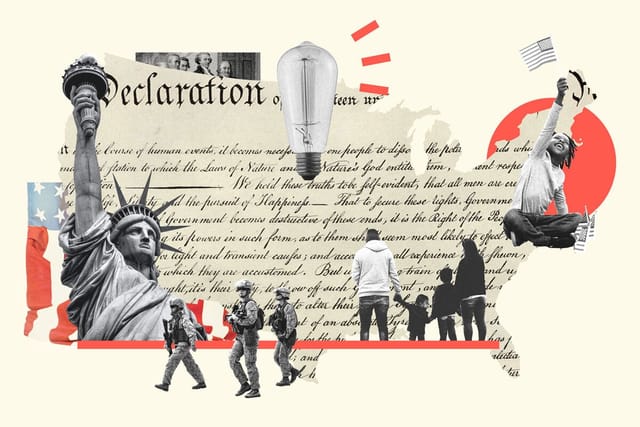
Most of us associate Independence Day with celebration, from grandiose fireworks displays to backyard barbecues. The 250th anniversary of our nation’s founding, however, comes at a time when celebration alone is not enough. We have to remember what the first Independence Day was all about: refusing to accept an unaccountable monarch’s abuses of power and creating the foundation for a government that is run by and for the people.
The Declaration of Independence, at its core, was a watchdog report. Our nation was founded on a promise of accountability — and 250 years later, we must ask ourselves whether we’re keeping this promise.
After years of being subject to the whims of a singular ruler, our founders dared to ask the question: What does it look like to create a government that answers to the people it’s meant to serve? And thus, the framers signed the Declaration of Independence. Our nation’s most foundational text is literally a 27-count public accounting of one ruler’s abuses of power: taxation without consent, a military turned against civilians, obstruction of accountability institutions, and more.
Following this document, our founders then created the Constitution, outlining how the government should work and who it should work for. Rather than consolidate power in the hands of a few, it deliberately separated power across an executive branch that represents the nation as a whole, a legislative branch that represents the interests of individual communities, and a judicial branch that upholds the Constitution over any one party or politic.
Our personal freedoms, financial stability, community safety, and more depend on these accountability mechanisms working the way our founders intended. If an executive can singularly plunge our nation into a war that everyday people don’t want, we pay the price in lost family members and skyrocketing costs. If our judiciary decides to prioritize partisanship over the Constitution, we lose our ability to shape our own futures.
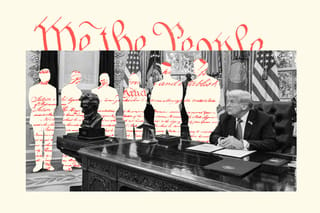
That is, unfortunately, exactly what we’re seeing play out today, and there is no shortage of examples. The Declaration of Independence may have centered on accountability, but in its first year alone, the Trump administration illegally fired nearly a quarter of the government’s inspectors general — the people tasked with combating waste, fraud, and abuse in federal agencies — and defunded the Council of the Inspectors General on Integrity and Efficiency (CIGIE), which ensures these federal watchdogs have the resources they need to do their jobs effectively. Meanwhile, it decimated our merit-based civil service, replacing nonpartisan federal workers with partisan lapdogs.
Just as Americans rebelled against soldiers patrolling our communities in the 1700s, we have once again had to fight back against the deployment of the military to our cities. On the eve of our 250th birthday, troops trained for war are illegally occupying our nation’s capital, costing us more than $1 million a day.
After years of enduring a monarch who treated the U.S. colonies as a personal piggy bank, our founders created a republic meant to prevent leaders from using their power of office to amass personal wealth. But today, we’re seeing lawmakers on both sides of the aisle benefit from insider trading, top White House advisors holding stock in companies profiting from the administration’s own policies, and major government contractors gifting massive sums to the lawmakers who oversee their work.
We find ourselves on the precipice of returning to the very form of government Americans rebelled against 250 years ago.
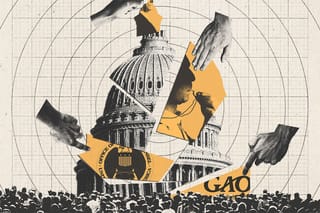
And it’s not just the executive branch eroding these protections. Congress, too, has abdicated its watchdog responsibilities; up until this month, it failed to exert its constitutional war powers to put an end to the president’s illegal war. It has time and again ceded the power of the purse —which belongs “the people’s branch” for a clear reason — to the administration.
In short, we are seeing a small but powerful group of public officials use their positions to destroy the accountability mechanisms that make our government work for us so that they can rule with impunity. We find ourselves on the precipice of returning to the very form of government Americans rebelled against 250 years ago.
But just as the founders fought against the monarchy over two centuries ago, we can fight back against these latest attempts to take power away from the people. That means demanding Congress take back its constitutional powers — from its warmaking authority to its power of the purse — so that these critical, life-changing decisions don’t rest with a singular leader. It means passing legislation to restore protections for a nonpartisan civil service and provide our inspectors general the independence and resources they need to make agencies accountable and effective. It means ensuring public officials are instituting policies based on the needs of the people and not their own bottom line.
We know that, in spite of our differences, we are united in a belief that our government should be responsive to our needs. We keep this belief alive not through sentiment alone, but with our actions.
The challenges we face today are urgent, but they are not new. The pillars of our democracy have been tested since our nation’s founding, and they have remained standing only because regular people have risen, time and again, to hold power to account. On our 250th anniversary, celebrating our nation is not enough — we must honor the founders by taking action to uphold the promise of accountability laid out in our founding documents.