Congress Can Impeach White House Officials
When high-ranking presidential aides abuse their power, Congress can (and should) use its impeachment power to investigate.
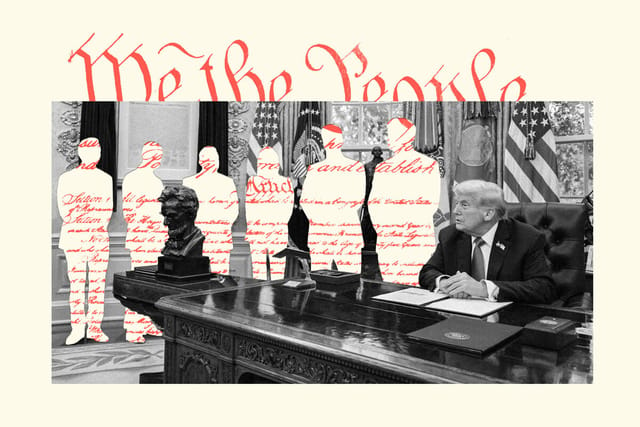
(Illustration: Leslie Garvey / POGO)
For decades, Congress has struggled to effectively oversee the executive branch. There is no single cause, but the effect has been a fundamental imbalance in the separation of powers: As presidents have grown more powerful, Congress has been less able to check them.
This inability to rein in presidents has led to acute harms during the current administration, as the executive branch has disregarded congressional appropriations and abused war powers and policing powers, with few effective checks from the people’s representatives.
Against this backdrop, it is essential for Congress to take stock of the powers it has and use them to their full effect. Of these, impeachment is one of the most powerful, because it belongs to Congress alone. And while impeachments are primarily thought of as a tool for holding presidents (unsuccessfully, particularly in the last 30 years) and judges (more successfully) to account, far more federal officials are subject to impeachment. Article II, Section 4 of the Constitution states that “[t]he President, Vice President and all civil Officers of the United States, shall be removed from Office on Impeachment for, and Conviction of, Treason, Bribery, or other high Crimes and Misdemeanors” (emphasis added).
If Congress wants to reclaim some of its authority, it would be wise to recognize the scope of the impeachment power. Beyond the prospects of securing the two-thirds majority needed for conviction — which may prove more achievable for executive branch officials than presidents — the process can provide Congress with a tool to pierce the secrecy that successive White Houses have built around some of the most powerful individuals in the executive branch: presidential advisors.
Constitutional Text
Congress’s impeachment power comes directly from the Constitution, which specifies who is responsible for conducting impeachments, who can be impeached, and what constitutes grounds for impeachment. However, the text leaves the categories of “who can be impeached” and “on what grounds” vague, and the clearest conclusion from the Constitution is that it is up to Congress to define them.
The Constitution is clear that impeachments are Congress’s domain alone. Article I, Section 2 provides that “the House of Representatives … shall have the sole power of impeachment.” Similarly, Article I, Section 3 states that “the Senate shall have the sole power to try all Impeachments.”
The Supreme Court held in 1993 that by giving the Senate the sole power to try impeachments, the Constitution deliberately limited judicial review over Congress’s decisions, and the “Senate alone shall have authority to determine whether an individual should be acquitted or convicted.” (The Chief Justice does preside over presidential impeachment trials in the Senate, but those powers are limited.)
The House has comparable, equally unreviewable authority over whether to impeach an individual and on what charges. As the U.S. Court of Appeals for the 11th Circuit wrote in granting a House committee’s request for access to grand jury materials for an impeachment probe in 1987, “only the House may decide whether to investigate, impeach, and prosecute public officials.”
As quoted earlier, Article II, Section 4 of the Constitution defines who is subject to impeachment and on what grounds, including “all civil officers of the United States.” The Constitution does not further define who qualifies as a “civil officer of the United States,” although clearly from the text it must be a civilian federal government official. Beyond that, though, the power to determine the range of impeachable officials lies with Congress.
The Congressional Research Service (CRS) wrote in 2023 that “which officials are to be considered ‘civil Officers of the United States’ for purposes of impeachment is a significant constitutional question that remains partly unresolved,” particularly as to executive branch officials who are not members of the Cabinet. They concluded, however, that given the House’s “sole power” to impeach and the Senate’s “sole power” to try impeachments, “the authority to resolve any ambiguity in the scope of ‘civil Officers’ for purposes of impeachment lays initially with the House, in adopting articles of impeachment, and then with the Senate, in trying the officer.”
That decision would likely not be subject to judicial review unless Congress’s actions plainly conflicted with the text of the impeachment clauses. As law professor Frank O. Bowman III wrote in his legal history of impeachment, High Crimes and Misdemeanors, “impeachment is one of the rare components of the constitution about which the courts have almost nothing to say….impeachment decisions are not judicially reviewable.”
Founders’ Views
The drafters of the Constitution and early commentators on its meaning clearly contemplated the possibility of impeachment being used against executive officials other than the president.
In England, Parliament did not generally have the power to remove the king or queen by impeachment, but it did have the authority to impeach other government officials. During the Constitutional Convention, Parliament was conducting impeachment proceedings against British colonial administrator Warren Hastings, which George Mason noted during the convention debates over impeachment.
There were also American impeachments before the federal Constitution was drafted and ratified. According to Bowman’s High Crimes and Misdemeanors, there were approximately 10 impeachments (or equivalents) against colonial officials before 1776, and 10 of the original 13 states included impeachment provisions in their constitutions.
In Federalist 65, Alexander Hamilton described impeachment as a means of inquiry into allegations of “misconduct of public men … from the abuse or violation of some public trust.” He noted that it was modeled on Great Britain’s and state constitutions’ impeachment procedures to act as “a bridle in the hands of the legislative body upon the executive servants of the government.” Similarly, James Madison said to the House of Representatives in 1789, “if an unworthy man be continued in office by an unworthy president, the house of representatives can at any time impeach him, and the senate can remove him, whether the president chuses or not.”
Influential early legal commentators on the Constitution also regarded impeachment as broadly available against executive officials. Supreme Court Justice Joseph Story wrote in his 1833 treatise, Commentaries on the Constitution of the United States, that other than military officers, all officers of the federal government “whether their duties are executive or judicial, in the highest or in the lowest departments of the government … are properly civil officers within the meaning of the constitution, and liable to impeachment.” Commentator William Rawle expressed the same view a few years earlier.
And yet, only two Cabinet officials have been impeached in the history of the United States, and both were acquitted. If the Constitution is clear on the authority to impeach executive branch officials, why has it happened so rarely?
According to Bowman’s history of impeachment, this is not because there was any question of Congress’s “undoubted authority … to impeach subordinate officials,” but because: “The issue has almost invariably proven moot. If the president said ‘Go,’ appointees went. Any appointee whose continued service was so politically toxic as to provoke a serious effort at impeachment has been shuffled off the stage.”
Given the current administration’s unpredictability and the president’s longstanding relationship with his most powerful and controversial aides, that may no longer be the case.
Defining Officers and Employees
The Congressional Research Service has suggested that to determine whether a particular executive branch official is properly subject to impeachment, Congress might look to legal court decisions interpreting Article II, Section 2’s Appointments Clause of the Constitution, because it contains language similar to that in the impeachment clause in Article II, Section 4. Specifically, both use the key phrase “Officers of the United States.”
The Appointments Clause gives the president the power to appoint “ambassadors, other public Ministers and Consuls, Judges of the Supreme Court, and all other Officers of the United States” only “by and with the advice and consent of the Senate.” It states, though, that Congress may pass laws authorizing appointment of “such inferior officers, as they think proper, in the President alone, in the Courts of Law, or in the Heads of Departments,” without the need for Senate confirmation.
Supreme Court case law recognizes a third category beyond principal and inferior officers: “employees,” who are not subject to the Appointments Clause’s requirements at all. In Buckley v. Valeo, the Supreme Court stated that “any appointee exercising significant authority pursuant to the laws of the United States is an ‘Officer of the United States,’” while employees are “lesser functionaries subordinate to officers of the United States.” The Supreme Court reaffirmed this standard in Freytag v. Commissioner, writing that officers, unlike employees, hold positions that are “established by law” on a permanent basis, and which involve the exercise of “significant discretion.” High-ranking White House officials clearly exercise significant discretion and their positions are established by law, but they do not have the same degree of legal authority as Cabinet secretaries, even if they are functionally more powerful.
Although the lines can be difficult to draw precisely, it does make sense to weigh an executive official’s legal authority and actual power in determining whether they can properly be subject to impeachment.
Neither the case law nor federal statutes provide perfectly clear dividing lines between superior and inferior officers, or officers and employees. The terms “officer” and “employee” both appear in the U.S. Code, but the statutes were primarily written in a different context than making distinctions under Appointments Clause case law. Many of them refer interchangeably to “officer[s] or employee[s].” “Officer” can be used to refer to military officers. “Employee” is sometimes used as a catch-all term to describe anyone who works for the government and receives their salary from the U.S. Treasury, including Cabinet secretaries, who are clearly “Officers of the United States” for Appointments Clause purposes.
The most relevant statutory definitions for Appointments Clause purposes — although at least one Court of Appeals has given them limited weight — may be the definition of “officer” found at 5 U.S.C. § 2104 and the definition of “employee” at 5 U.S.C. § 2105. Both groups perform federal duties and are employed by the federal government, but “officers,” unlike “employees,” must be appointed and supervised by the president, a court, or the head of an executive agency or military department — the same group to whom Congress may delegate the appointment of inferior officers under the Appointments Clause. “Employees,” in contrast, can be supervised by other federal employees.
Although the lines can be difficult to draw precisely, it does make sense to weigh an executive official’s legal authority and actual power in determining whether they can properly be subject to impeachment. Impeachment investigations into lower-level employees would be a poor use of limited congressional oversight resources. They could be abused to target individual federal employees for harassment or retaliation, particularly whistleblowers, dissenters, or employees from vulnerable communities.
But the existence of the category of “inferior officers” clearly demonstrates that executive officials who lack the formal power of an agency head and are not confirmed by the Senate can nonetheless qualify as “officers of the United States” for impeachment purposes.
Growth of White House Staff in Size and Power
Although White House officials do not face Senate confirmation and do not have the formal authority of Cabinet secretaries, some have more actual power than almost anyone in the executive branch.
The existence of a large White House staff involved in high-level policymaking is a modern phenomenon. In the earliest years of American history, presidential staff primarily included personal servants — many of whom early presidents enslaved — and a paid personal secretary, often a relative. In 1857, Congress began regularly appropriating funds for the president’s staff, but the number of positions was very small: a personal secretary, a steward, and a messenger.
Congress authorized the creation of the modern Executive Office of the President in the Reorganization Act of 1939, based on recommendations from a commission convened by President Franklin Delano Roosevelt. The commission found that, given the expansion of the executive branch, the president’s “immediate staff assistance is entirely inadequate.” To remedy this, it recommended hiring at most six executive assistants to assist the president in gathering all relevant information from executive agencies to inform their decisions and inform agencies of what was decided.
The commission emphasized the need for these aides to act with restraint, saying, “These aides would have no power to make decisions or issue instructions in their own right. They would not be interposed between the President and the heads of his departments. They would not be assistant presidents in any sense.”
Today the Executive Office of the President has approximately 1,700 employees. The White House Office, which generally employs the president’s closest advisors, has hundreds.
The current statute authorizing these positions, 3 U.S.C. § 105, is relatively simple. It authorizes the president to “appoint and fix the pay of employees in the White House Office” without Senate confirmation and without regard to most federal civil service and hiring regulations, to “perform such official duties as the President may prescribe.” Up to 25 of these positions can receive a salary equivalent to a deputy Cabinet secretary.
The statute shows clear congressional intent to allow presidents to select their closest aides without Senate confirmation. But it also shows that these aides’ positions are established by law and involve close proximity to the president, high salary, and the exercise of as much discretion as the president chooses to allow. Increasingly, presidents have delegated authority to members of White House staff to set policy and effectively supervise and give orders to Cabinet officials and other Senate-confirmed agency heads.
It would be strange if the impeachment power extended to both presidents and Cabinet secretaries but not the officials who stood between them.
Piercing the Veil of Executive Privilege
Impeachment inquiries into White House officials involved in serious abuses of power have become one of the only plausible mechanisms for an official government investigation of those abuses. As Bowman wrote:
[T]he undoubted authority of Congress to impeach subordinate officials carries with it the associated powers of the House to investigate potentially impeachable conduct … because impeachment authority is directly and exclusively granted to Congress, the courts have been especially willing to enforce congressional investigative demands.
Unlike Cabinet secretaries, White House officials rarely testify before Congress. The executive branch has repeatedly argued that these officials cannot be compelled to respond to subpoenas or provide documents to committees because they are functionally “alter ego[s]” of the president. According to the Justice Department, questioning presidential aides about White House deliberations is akin to forcing the president to testify, and is therefore unconstitutional.
In the context of impeachment, the executive branch’s claim that presidential advisors are “alter egos” of the president may actually bolster Congress’s argument.
The courts have rejected the most extreme forms of this argument but have held that presidents’ communications with their closest advisors are privileged against disclosure in litigation, including efforts to enforce congressional subpoenas (one of several types of executive privilege).
The presidential communications privilege protects not only presidents’ communications with their closest advisors but also communications between those advisors and other government officials, as well as related documents. It is not an absolute privilege and can be overcome if Congress or other parties to litigation can demonstrate the need for the evidence.
Unfortunately, the Supreme Court has been far more deferential to presidential claims of privilege than congressional assertions of the need for information. In Trump v. Mazars USA, LLP, the high court held that even when Congress subpoenaed non-privileged information about the president, Congress had to “establish that a subpoena advances a valid legislative purpose,” and that merely exposing wrongdoing or potential violations of law did not qualify.
This argument would not apply in the impeachment context, however, which could reduce (though not eliminate) the extensive delays involved in enforcing subpoenas in the courts. Impeachment hearings could also serve as a forum for cooperating witnesses to give evidence.
More fundamentally, in the context of impeachment, the executive branch’s claim that presidential advisors are “alter egos” of the president may actually bolster Congress’s argument: If that is indeed the case, then why should the advisors be immune from a process presidents are themselves subject to?
Conclusion
It is increasingly hard to imagine a body other than Congress successfully investigating misconduct by White House officials. During this administration, President Donald Trump has fired inspectors general en masse and shuttered oversight offices. The government has invoked executive privilege to prevent testimony about White House officials’ involvement in deportation decisions and use of force by immigration agents, and the Office of Legal Counsel has concluded that it is unconstitutional to require the White House to preserve presidential records. Obstacles to criminal investigations are even higher.
Impeachment was created centuries ago and adopted by the founders to prevent executive impunity. Congress should not be afraid to use it to investigate wrongdoing by the president’s closest and most powerful advisors.