OMB’s Latest Attempt to Sideline GAO
The administration’s continued attacks on GAO undermine government efficiency, weaken accountability, and risk more waste across federal programs.
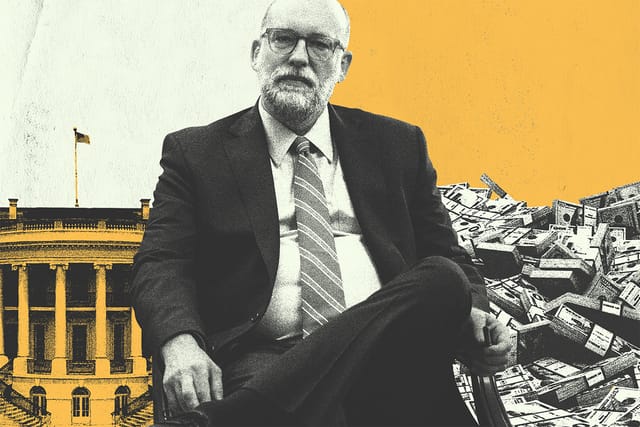
(Illustration: Luna Velez / POGO)
Russell Vought is at it again, targeting one of Congress’s most effective tools for ensuring accountability across the federal government: the Government Accountability Office (GAO). Last month, Vought, the director of the Office of Management and Budget (OMB), released updated guidance for executive branch agencies about the internal controls that are meant to address fraud, waste, and abuse; this new guidance will likely reduce the agencies’ use of standards and recommendations from GAO. As POGO previously highlighted, this is just the latest in a broader effort to undermine Congress’s watchdog. But undermining GAO doesn’t strengthen government — it undermines accountability.
For over 100 years, the independent, nonpartisan GAO has worked to improve government efficiency and save taxpayer dollars. Housed within the legislative branch, the agency is an invaluable resource for Congress in assessing agency and program performance. Sometimes referred to as Congress’s auditors, GAO audits and investigates executive branch programs, reviews agency contract awards to ensure they are above board, and makes recommendations to improve performance and ensure accountability.
Since 2002, GAO’s work has led to over $1.51 trillion in savings for the federal government. In 2025 alone, GAO produced more than 1,800 new recommendations and saved taxpayers $62.7 billion. Those savings are not accidental; they depend on agencies’ long-standing practice of recognizing GAO’s nonpartisan expertise and accepting and acting on its recommendations. In fact, between 2011 and March 2025, Congress and agencies fully addressed 71% of the matters and recommendations made by GAO, and partially addressed 6%. This high rate of implementation reflects agencies’ view of GAO as a trusted partner in improving government operations.
As an agency of professional auditors, GAO is uniquely positioned to help agencies across the executive branch review their programs. In fact, Congress mandated in 1982 that GAO set guidelines and standards for the internal controls that federal agencies use when reviewing their programs; this is to ensure agencies run their operations efficiently and effectively, report reliable information, and comply with applicable laws and regulations. Federal agencies, through OMB, are required to ensure their internal controls comply with the guidelines and standards established by GAO.
Having standardized internal controls across government allows for more uniform operationalization and assessment of programs. Because agencies are responsible for evaluating and reporting on their own programs, if they set their own internal controls without adhering to government-wide standards, they risk inconsistencies in how results are measured and reported. For example, while there are 13 federal agencies primarily tasked with funding broadband expansion, GAO identified over 100 federal programs at 15 agencies that could fund broadband expansion. Without the government-wide lens that GAO offers, it becomes far more difficult to assess performance and ensure taxpayer dollars are spent effectively.
However, if OMB Director Vought has his way, GAO would be sidelined altogether. This is not a new position — in September 2025, Vought stated GAO “shouldn’t exist.” In the recent guidance from March 2026, he wrote that federal agencies have “overly deferred to the direction and priorities of external entities whose views are not binding on the Executive Branch such as the Government Accountability Office. Doing so has failed to prioritize agency internal control processes to adequately protect American taxpayer dollars, leading to documented examples of widespread abuse.” In effect, OMB is telling agencies to rely less on independent, government-wide expertise and instead to set controls in isolation.
In his guidance, Vought wrote that it’s important to “effectively manage the internal control process.” Given that, OMB and agencies ought to welcome scrutiny and the efforts to identify improvements, not seek to avoid them. A well-run agency should be able to incorporate independent expertise, especially from an agency that exists to address government waste, fraud, and abuse.
If the administration is serious about efficiency and saving taxpayer money, OMB ought to be reinforcing that alignment by encouraging agencies to work closely with GAO.
Sidestepping independent expertise risks failing to identify waste and inefficiencies. For an administration that has championed government efficiency — including through the creation of the Department of Government Efficiency (DOGE) to work with other agencies on it — one would expect officials to prioritize inter-agency and cross-branch collaboration. Government efficiency cannot be achieved by one branch alone, and Vought’s guidance will only exacerbate inefficiencies in federal agencies.
While executive branch agencies should not delegate the setting of internal controls to GAO, they are supposed to ensure those controls align with GAO’s professional standards. If the administration is serious about efficiency and saving taxpayer money, OMB ought to be reinforcing that alignment by encouraging agencies to work closely with GAO.
OMB’s ongoing hostile and uncooperative posture on GAO stifles the government’s ability to enforce the proper checks and balances that are crucial to tracking how our taxpayer dollars are being spent. This posture has previously affected smaller executive agencies’ attitude toward GAO when it’s performing tasks for Congress: For example, in June 2025, the Institute of Museum and Library Services, a non-Cabinet-level independent agency, did not cooperate with GAO’s investigation into improperly withheld funds. While this example predates the recent guidance, it underscores a broader pattern of resistance that the new guidance could exacerbate by signaling that agencies are expected to cooperate less with GAO.
GAO’s track record of saving taxpayer dollars speaks for itself. Not only should executive branch agencies ensure their internal controls are consistent with the standards established by GAO, which have proven so effective, but they must also work to implement and close the nearly 5,300 open GAO recommendations.
It’s worth noting that Congress has a role to play here, too. Congress should be alarmed by OMB’s attempts to undermine its watchdog and defend this critical agency. A strong GAO helps Congress achieve its key constitutional duties to conduct oversight and ensure taxpayer dollars are spent wisely and efficiently. A weakened GAO risks Congress’s ability to serve as a check on the executive branch, and increases the likelihood that taxpayer dollars will be wasted.
Specifically, Congress should encourage Vought to rescind his recent guidance. If the guidance is not rescinded, Congress can use its appropriations and oversight authorities to ensure agencies continue to follow GAO standards. Moreover, Congress should ensure OMB makes it clear that GAO should be viewed as a partner, and not an adversary.
This issue extends beyond a single piece of guidance and reflects how the administration views the role of independent oversight. As Congress’s watchdog, GAO plays a critical role in helping identify waste, strengthen internal controls, and safeguard taxpayer dollars. Efforts to undermine that role risk weakening the very checks and balances that would make government more effective, efficient, and accountable. Preserving a strong, collaborative relationship between executive agencies and GAO is critical, and Congress must defend their watchdog.