Portland Precedent Risks More Unchecked, Unlawful Deployments
The Pentagon is using the president’s June memo as a blanket authorization to deploy troops to U.S. cities — regardless of the facts or the law.
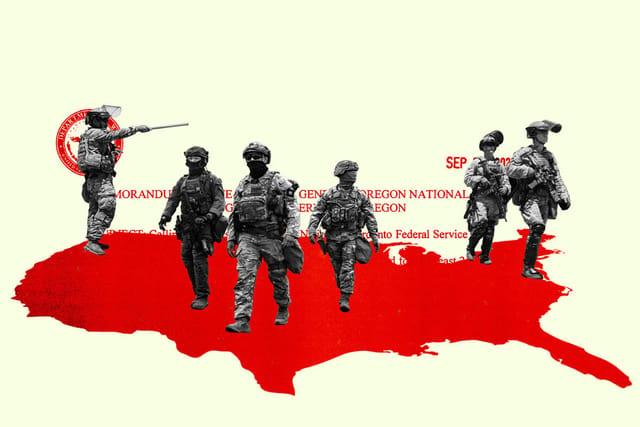
(Photos: Department of Defense)
One day after President Donald Trump wrote on social media that he was ordering troops to “War ravaged Portland,” Defense Secretary Pete Hegseth issued a memo calling 200 members of the Oregon National Guard into federal service. In his two-paragraph document, Hegseth explained that service members would protect Immigration and Customs Enforcement (ICE) agents, other federal agents, and federal property. The memo, Hegseth wrote, “implements the President’s direction.” Attached is another document, signed by Trump, that calls for deploying National Guard and active-duty troops to American cities.
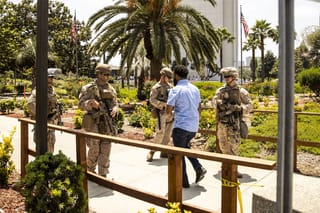
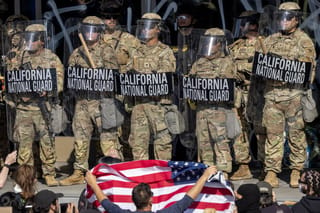
It’s dated June 7, 2025, and it was written to facilitate the federalization of the California National Guard and the deployment of Marines in Los Angeles.
Hegseth’s Portland order represents a dangerous escalation in the ongoing efforts to militarize American cities, with the president providing no new official documentation to explain why the administration believes it needs to override the elected leaders of Portland and Oregon and send troops onto their streets.
In fact, the Portland deployment makes it clear that the administration is prepared to deploy the military anywhere there’s a protest — without any further justification — and that it seems willing to blow through legal limitations on troops’ conduct.
A Never-Ending Authorization?
In the last few months, Trump has threatened to send the National Guard into Washington, Memphis, Chicago, Baltimore, and other cities across the country. POGO’s not alone in writing about the dangers of domestic deployment to people’s safety and liberties.
Making matters worse is the origin of Sunday’s memo. Even if the facts on the ground justified it, the power to federalize the National Guard belongs to the president. But the Portland memo came from Hegseth. The implicit claim is clear: The Secretary of Defense now has the power to federalize the National Guard because of a vague memorandum signed by the president in June.
With this new deployment, the administration is sending a clear signal that it intends to treat Trump’s June memo as a standing authorization. Moving forward, Hegseth may federalize members of the National Guard and send them to any community across the country, directed by little more than a Saturday morning social media post.
No Legal Justification
The law Hegseth purports to invoke to justify the federalization and deployment of troops, section 12406 of Title 10, applies only in cases of “invasion,” “rebellion,” or when “the President is unable with the regular forces to execute the laws of the United States.” The first time Trump invoked this authority, in Los Angeles, the facts on the ground did not meet any of these criteria.
In Portland, the situation is even farther from the law’s conditions. There have been protests against ICE in Portland, as in many cities. But as Oregon and Portland wrote in a lawsuit challenging the deployment, “those protests have been small in recent weeks — typically involving less than thirty people,” and Portland police had not had to make any arrests related to those protests in over three months. (There were two reported arrests at a protest the evening after the lawsuit was filed.)
It’s essential for the courts to move faster than they have in California’s case and re-emphasize the protections of the Posse Comitatus Act, and the guardrails against sending troops into our cities in the first place.
It should not have to be said, but we will say it: Protests — even ones where some individuals cross the line into criminal activity — are not rebellions, and they do not justify federal military intervention.
Perhaps this is why Hegseth’s memo makes no attempt to justify deploying troops based on conditions on the ground: It simply could not be done. But the combination of an apparently standing authorization to federalize troops and a willingness to do so without even the fig leaf of an explanation is deeply dangerous.
Limits on What Troops Can Do
Although this administration seems intent on ignoring it, there is an important law that still applies, despite these escalations. The Posse Comitatus Act establishes the basic principle that the military cannot perform police activities outside of very specific circumstances.
A federal judge recently confirmed that the statute the administration is using to authorize this deployment does not suspend Posse Comitatus: The National Guard and other troops cannot do police work. That judge also ruled that certain things the National Guard did in L.A., like setting perimeters and traffic checkpoints around ICE agents conducting immigration enforcement, illegally put troops into police roles.
Despite that rebuke, the authorization for the Portland deployment “further implements the President’s direction” in calling for National Guard troops “to protect U.S. Immigration and Customs Enforcement” officers, which certainly sounds like guarding ICE agents as they perform law enforcement duties.
A Terrifying Precedent
We’ve written extensively about the many dangers of using the military as an occupying force within our country. It puts people in danger, makes our country less safe, undermines our constitutional system, and wastes taxpayer money. Sending the National Guard to Portland is dangerous — as is sending troops to Los Angeles, Washington, and Memphis.
As the Portland deployment makes clear, things are getting more dangerous. It is evident that the Trump administration is willing to answer even small, peaceful protests against federal law enforcement with a military response. And now, the Pentagon believes there is a standing presidential order allowing it to federalize state National Guards at will.
Oregon is right to have challenged this deployment in federal court, much like California did earlier in the summer.
It’s essential for the courts to move faster than they have in California’s case and re-emphasize the protections of the Posse Comitatus Act, and the guardrails against sending troops into our cities in the first place.