NDAA Amendments to Improve National Security
Letter to the House Rules Committee encouraging them to support defense budget amendments that will help strengthen national security.
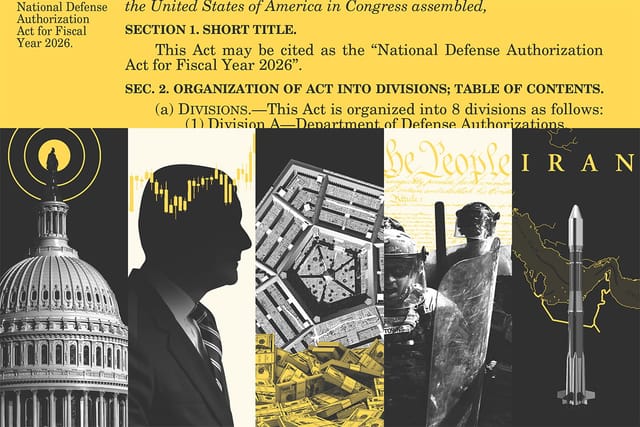
(Illustration: Luna Velez / POGO)
To:
- The Honorable Virginia Foxx
Chairwoman
House Rules Committee
H-312 The Capitol
Washington, DC 20515 - The Honorable Jim McGovern
Ranking Member
House Rules Committee
H-152 The Capitol
Washington, DC 20515
Dear Chairwoman Foxx and Ranking Member McGovern:
The Center for Defense Information and the Project On Government Oversight (POGO) have worked to promote a strong, efficient U.S. defense establishment for nearly half a century. POGO is a nonpartisan, independent watchdog that investigates, exposes, and champions reforms on systemic corruption, abuse of power, and waste. As such, we feel it is important to flag sections of next year’s National Defense Authorization Act (NDAA) that we believe will improve military readiness, reduce wasteful spending, and provide safer environments for our service members and the people they protect.
As the House Rules Committee considers amendments, we have identified a selection that we believe merit particular consideration. We’ve grouped these select amendments into five key focus areas: conflicts of interest, military support to domestic law enforcement, congressional oversight, war powers, and top line budget considerations.1
Conflicts of Interest
Financial conflicts of interest corrode public trust. We have continually advocated for reforms that would limit opportunities for these conflicts to arise and close loopholes that enable conflicts (either perceived or actual) to exist. We have a history of advocating for congressional stock-trading bans and other similar reforms.2 Most recently, we have weighed in on the potential for corruption surrounding prediction markets.3 As such, we support the following amendments addressing conflicts of interest as they pertain to the Department of Defense (DOD): Amendments 168, 621, 630, and 941.4
Military Support to Domestic Law Enforcement
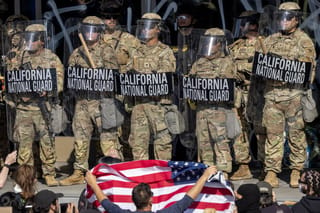
Since mid-2025, we have worked to highlight the domestic deployment of the National Guard and other federal troops to U.S. cities as a dramatic overreach of executive power that normalizes the presence of uniformed federal forces in American cities. We maintain that these deployments are often legally dubious and do serious damage to public safety, military readiness, and civil-military norms.5 We have repeatedly urged Congress to use its constitutional powers to reverse these deployments and practice necessary oversight of the executive branch in future deployments.6 As such, we strongly support the following amendments that address this issue: Amendments 3, 15, 159, 252, 462, 622, 838, 1074, and 1075.7
Congressional Oversight
It is vital to our national security that Congress frequently and appropriately exercise necessary oversight of the DOD to ensure the military is being run accountably and efficiently. We frequently call for Congress to increase oversight efforts in a variety of areas, such as protecting the power of the purse, strengthening the role of inspectors general, and promoting transparency in government operations.8 As such, we are encouraging members to support the following amendments: Amendments 210, 299, 486, 551, 575, 597, 641, 645, 693, 975, and 1013.9
The power of the purse is a vital tool of congressional oversight, and ensuring the DOD spends taxpayer money appropriately is a major part of that power. We have argued in the past that the Pentagon’s inability to pass a clean financial audit is both a glaring emblem of waste and an obstacle to finding and rooting out that waste.10 We believe Congress needs to use the power of the purse to force the issue and support legislation penalizing the DOD for its failure, rather than continuing to reward the only federal agency to never pass an audit.11 As such, we strongly support the following amendments pertaining to the DOD audit: Amendments 138 and 298.12
War Powers
We believe that the Constitution unambiguously gives Congress — not the president — the power to declare war, and that the open-ended Authorizations for Use of Military Force (AUMFs) that have carried the legal weight to justify more than a dozen conflicts worldwide have deviated from their original purposes. We regularly call for the repeal of these past AUMFs and for legislation that will shore up and reaffirm Congress’s constitutional war powers.13 And we remain concerned that Congress hasn’t passed any AUMFs for conflicts such as Operation Epic Fury and Operation Southern Spear. We believe the following amendments will help promote these goals, and we encourage members to support them: Amendments 207, 209, 232, 238, 240, 296, and 1006.14
Top Line Budget Considerations
We are not shy in our assertions that the Pentagon budget was already bloated and poorly managed prior to this year’s skyrocketing budget proposals.15 We believe this year’s record-breaking $1.5 trillion proposed budget does not improve national security, but merely throws more money at an already wasteful, inefficient system. After years of failed audits and reckless spending, the Pentagon needs rigorous oversight, not an unjustified raise. Without major reforms, we will oppose these top line increases to the budget. In fact, we advocate that until Congress passes a budget in regular order, we support returning to the spending levels of the FY 2025 budget, the last one passed in regular order. As such, we were thrilled to see amendments put forward to address this issue, and we wholeheartedly support them: Amendments 511 and 673.16
Thank you for your consideration of the merits of these amendments. If you have questions regarding our support or opposition to any specific section, please reach out to me at [email protected].
Sincerely,