The Corruption Vortex
When high-ranking government officials can profit from the crypto industry, prediction markets, and stock trading, corruption can thrive.
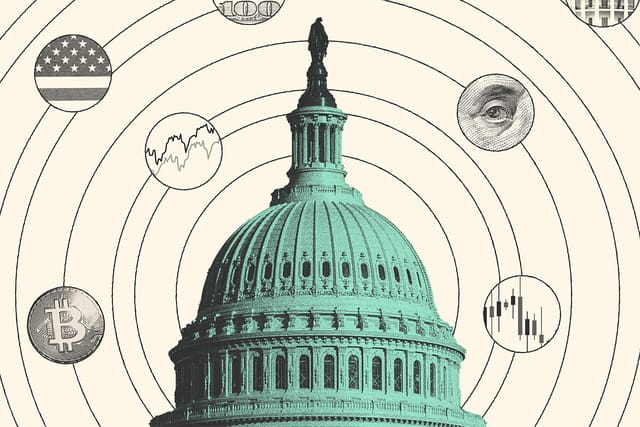
(Illustration: Luna Velez / POGO)
With over four decades of experience and expertise in fighting government corruption, we at POGO have seen a wide variety of malfeasance and wrongdoing. Our work has spanned Republican and Democratic administrations and every possible permutation of power in Congress. It is with this grounding in our historical purview and our consistency in speaking truth to power, without fear or favor, that we can say with certitude that we have never seen anything like what we are seeing today — and have been seeing for the past 20 months or so — in terms of brazen corruption, self-dealing, and unabashed cronyism and conflicts of interest.
At the start of his administration, President Donald Trump failed to issue an executive order laying out additional ethics restrictions for appointees, as he did in his first term and as other presidents have done in the past. A pattern of corruption became evident almost immediately upon the commencement of this administration, and it has proceeded frenetically ever since. From naked pay-to-play donations to the presidential inauguration, to suspicious donations to projects like the White House ballroom, to no-bid contracts handed out to businesses with ties to campaign contributors, the pattern continued. The litany has also included pardons for the rich and well-connected; efforts to fully immunize the president, his family, and other parties from a vague list of current and pending cases; and potential sweetheart deals for individuals and companies with connections to the president, his family, and their affiliates.
Amidst these uses and misuses of the levers and resources of the federal government — all ultimately funded by American taxpayers — there have emerged three especially problematic vectors of corruption, cronyism, and conflicts of interest. The crypto industry, prediction markets, and stock trading by high-ranking government officials have proven exemplary case studies showing how regulatory and accountability gaps allow corruption to thrive in the federal government, and how desperately those gaps need to be addressed.
Issues related to government corruption are not new, nor are they exclusive to any one party, administration, or ideology. Corruption is a systemic problem, and one that POGO has been calling out and fighting against for the entirety of our existence. Whether it is concern around the revolving door between the Department of Defense and the defense industry, the corrosive effects on government contracting of former officials turning into industry lobbyists, excessive secrecy and its deleterious impact on accountability, or the cozy relationship between contractors and entities charged with overseeing those companies, the insidious phenomena of corruption, cronyism, and conflicts of interest have been with us for a long time.
Roughly 9 in 10 Americans have recently expressed their discontent around government corruption in public opinion surveys.
Corruption in government is no mere academic abstraction. The lack of ethics and integrity on the part of some high-ranking government officials — including, arguably, the highest-ranking official of them all — is not a partisan distraction. These things act as a sickness in the body of the federal government, eating away at the healthy parts and making the entire organism more brittle and less effective.
When precious, finite public resources are squandered through federal contracts awarded to cronies, this means fewer resources are available for vital public investments. Congress has long recognized the power of federal spending to support small businesses, rural communities, veterans, and others. The people making critical decisions on how resources are allocated have the power to benefit the public for the general good or to favor a small handful of narrow interests and reward the well-connected. If they choose the latter, the opportunity costs to everyday Americans are not only morally objectionable — they can also cause real harm.
Roughly 9 in 10 Americans — just over 80% of Republicans and 90% of Democrats and independents — have recently expressed their discontent around government corruption in public opinion surveys. This is why being aware of corruption in government matters, and why watchdogs like POGO and civically minded public servants must continue to fight against it. As such, it is imperative that Congress move swiftly to enact essential anti-corruption, pro-accountability reforms as soon as possible. The corruption vortex is here, and it threatens to consume everything in its wake.
Crypto Corruption
Like any other financial instrument, crypto currency and other digital assets pose a systemic corruption risk. If these kinds of assets can be traded, bought, sold, and invested in, then they can lead to insider trading, conflicts of interest, and movement of illicit funds. This is an especially acute and potent risk when government officials are at once investing in these assets for their own financial benefit, regulating the underlying markets in which those transactions happen, and shaping and implementing policy that can have both direct and indirect effects on the values and economic environment in those sectors. In other words, conflicts and corruption are baked into the bedrock of the system, and the advent of crypto as an increasingly prominent investment and speculation vehicle is just one of the latest manifestations of a longstanding threat to the integrity of the policymaking process and those who participate in it.
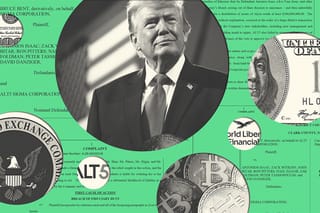
The intersection between the Trump administration, the president himself, the president’s family, and the crypto industry has been reported on extensively. This includes recent POGO Investigates reporting on a dubious payout related to the Trump family crypto complex that resulted in a windfall for the family and left company shareholders on the short end and questioning the deal. Despite widespread reporting, this noxious nexus’s scale, scope, and persistence justifies further discussion.
After initially expressing some pointed skepticism surrounding the advent of crypto a few years ago, President Trump later came to fully embrace the industry. His about-face included the launching of his own crypto company, his own meme coin, and his own stable coin. It is worth observing that the crypto industry massively ramped up its campaign spending in the 2024 election cycle, to the tune of at least $119 million, benefitting both Democratic and Republican candidates.
It is an understatement to say crypto appears to be a key axis of the corruption, cronyism, and conflicts of interest arising over the last 20 months.
What is likely most concerning is the extent to which the president has financially benefitted through his crypto ventures, a windfall that has reached at least $1.4 billion according to the latest financial disclosure data and related reporting. Also notable is what a light touch the Trump administration has taken in terms of regulating the crypto industry since taking office in 2025. This has included dissolving a dedicated crypto crimes unit at the Department of Justice (DOJ), the cessation or weakening of numerous ongoing enforcement and investigative actions related to crypto at the Securities and Exchange Commission, and the nomination of individuals who are connected or friendly with the crypto industry to key positions in the administration. Regarding the latter, it is instructive to note that many of these individuals have served in similar roles under previous administrations, underscoring how deep and bipartisan the problem is. Most recently, the Trump family crypto firm was conditionally approved for a charter, likely affording it the prestigious distinction of becoming the first crypto venture to ever receive official chartering as a bank by Office of the Comptroller of the Currency, housed within the Treasury Department, an agency under the direct authority of President Trump.
In combination with recent and ongoing reports of foreign influence and overseas financial ties to the Trump family crypto complex, it is an understatement to say crypto appears to be a key axis of the corruption, cronyism, and conflicts of interest arising over the last 20 months. With the crypto industry already reportedly injecting astronomical sums of campaign and political spending into the 2026 midterm election cycle and having become very active influence peddlers, this dynamic and its corrosive effects on government integrity and public trust seem likely to proceed unchecked unless Congress intervenes with meaningful reforms and guardrails.
Prediction Markets: A New Frontier for Potential Corruption
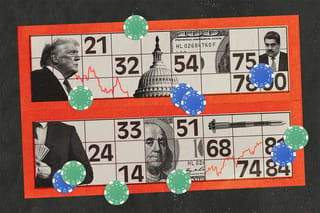
Though nowhere near as well-established as the crypto industry, the prediction markets sector — the venue in which “event contracts” are traded in volumes that recently reached $24 billion per month, outstripping traditional online sports betting by about $10 billion — is rapidly becoming a major player and concern from the standpoint of government corruption and integrity.
Throughout 2026, POGO has been raising the alarm on the insider trading and national security risks associated with government officials potentially gaming the prediction market system by using sensitive nonpublic information for their own gain. News around bets on the content of presidential speeches, the outcomes of elections, and the actions of former members of Congress show the breadth, if not the full scope, of insider bets on prediction markets. Reports of military personnel using classified information on sensitive military operations to profit off of these markets has brought into clearer focus the risks and dangers posed by government insiders trading in prediction markets.
There’s significant overlap between the concerns around crypto and those attending prediction markets, but two important commonalities stand out. The first is that there are clear shortcomings around regulation and enforcement. While some states have taken steps toward regulating prediction markets, the current federal regulations enforced by the Commodity Futures Trading Commission (CFTC) fall woefully short.
Another commonality between the crypto corruption miasma and prediction markets is the direct connection between the industry and President Trump’s family. In this case, one of the president’s sons — Donald Trump Jr. — is an investor in Polymarket and a strategic advisor to Kalshi, both major prediction market companies. Earlier this year, he also reportedly urged state attorneys general to go easy on the policing of prediction markets, a request that appears aligned with the CFTC’s aggressive assertion of its exclusive authority to regulate prediction markets.
When taken together, the clear risks of systemic corruption presented by prediction markets, alongside the connection to the Trump family and its financial interests, renders the broad matter of prediction market regulation and reform an essential component of any anti-corruption effort.
Stock Trading by Government Officials: The Perennial Scandal
Investing in the stock market is a normal part of the American financial experience. In 2025, 62% of Americans were invested in the stock market, mostly through vehicles like retirement accounts. That being said, everyday Americans have neither the access to nonpublic information nor the power to shape market-moving economic policy that government officials across all three branches do.
For years, POGO has called on leaders of both parties for a ban on stock trading by members of Congress and their immediate families. To again underscore the point that stock trading by government officials is a bipartisan scourge, note that former Speaker Nancy Pelosi (D–CA) and her husband are notoriously prolific stock traders and, in some ways, typify the problem. Even more alarming is recent analysis showing that ascending to congressional leadership also appears to bring with it massive additional returns to the performance of those members’ stock portfolios, even when compared to rank-and-file members of Congress. The fact that this ethical travesty has yet to be eliminated is a stain upon the entire institution of Congress. But it isn’t just Congress that has a conflicted and corrupt stock trading problem.
When share prices of companies are distorted in some way as a result of presidential or congressional action, that impacts things like retirement savings and general financial planning for everyday Americans.
We learned this summer of extraordinary volumes of stock trading by President Trump’s investment advisors over the preceding year, totaling tens of thousands of trades as the president amassed a stock portfolio worth more than $850 million. Reporters have documented instances of the president publicly promoting companies in which he is invested. To add another insidious layer to the conflicts of interest at play here, there were also instances in which the president invested in companies in which the federal government has taken equity ownership stakes, creating potential conflicts in the personal investment, the federal investment, and any future decisions on policies like subsidies and contract awards to those same companies. To put it simply, the conflicts of interest and corruption at play here — and the shamelessness with which they are being carried out — is staggering.
The issue here extends beyond moral outrage and high-minded notions of the proper ethical conduct of government officials. Those things matter, but this kind of corruption has concrete effects for other people. When share prices of companies are distorted in some way as a result of presidential or congressional action, that impacts things like retirement savings and general financial planning for everyday Americans. When tariff announcements are preceded by a flurry of stock trades, it signals to the American people that those with advanced inside knowledge are able to protect their own financial positions while everyone else takes financial hits. These effects highlight the fundamental unfairness that lies at the core of the current status quo and further demonstrates the urgent need for reform.
Reforms to Combat Corruption
To aid in fighting corruption and reducing conflicts of interest in the federal government, some key, longstanding, and well-understood reforms can help.
- Amend 18 U.S.C. Section 208 to cover the president and vice president. This is a reform that POGO and others have called for over the years and decades. Section 208 is the criminal conflict of interest law that applies to literally every other official and employee within the executive branch except the president and vice president. By amending the law to cover the two most powerful officials in the executive branch, this law will finally serve its intended purpose of deterring conflicts of interest and providing accountability for their corrosive effects.
- Codify a law that rescinds the DOJ’s internal policy that prevents a sitting president from being prosecuted for federal crimes while in office. This reform is necessary in order to render the first reform we suggest operative. DOJ has had this internal policy for decades, and it represents an existential challenge to the notion of the president being subject to the rule of law. For reasons related to conflicts of interest, as well as broader accountability, Congress should take action to legally require DOJ to treat the president the same as anyone capable of committing a crime.
- Prohibit federal officials across all three branches from trading stocks and other similar financial assets while in office. Given the ease with which the president, agency officials, members of Congress, and federal judges can obtain and utilize inside information to game the system and financially benefit themselves at the expense of the public, there must be a clear, unequivocal reform in response. Such a reform should ban these officials and their immediate families from trading stock and engaging in similar financial transactions — including crypto and prediction markets — while serving in their public positions. Commonsense allowances for investments in broad-based mutual funds and exchange-traded funds are always acceptable in these kinds of reform efforts, but the status quo is most certainly not acceptable.
- Prohibit certain categories of event contracts from being permissible on prediction markets. Beyond the matter of insider trading by government officials in placing prediction market trades, there is a foundational question as to whether certain events should be tradeable at all. In our view, the answer is an unequivocal negative. Event contracts pertaining to matters of war, terrorism, illegal acts, political or electoral outcomes, and other events contrary to the public interest should be flat-out banned. Existing CFTC regulations are supposed to prohibit this kind of event contract trading already, but CFTC enforcement is uneven at best, and legal codification is the way toward a more durable enforcement system.
- Work with the Office of Government Ethics to identify the gold standard of previous presidential ethics pledges for incoming appointees and codify those standards. Generally, new administrations rescind the previous order and sign a new one, creating confusion for officials and ethics personnel. By codifying ethics best practices, Congress will ensure there are no gaps and that each administration holds its appointees to the same standards.
Conclusion
These issues are not especially new. Government officials have been trading stocks since stocks have existed, and it has always been an untenable ethical scourge. New forms of financial engineering and enrichment — like crypto currency — simply put old potential conflict of interest wine in a new government corruption bottle.
What is new is the brazen shamelessness with which current government officials, including and most egregiously the president, are engaging in and reinforcing these problems. When asked in an interview why he placed fewer restrictions on his family’s international dealings in his second term, President Trump was direct: “I could have done so many deals, and I didn’t do deals ... [then] I found out that nobody cared. I’m allowed to.”
This moment is another historical inflection point for the federal government and for the country as a whole.
Given how little Congress has done to resolve these issues of corruption or the gaps in the legal framework that governs them, and considering how small a price government officials appear to have paid for this corruption, it is hard to blame the president for feeling that way.
None of this, however, is an excuse for continued inaction and complacency. Congress must act aggressively to conduct oversight and investigate the myriad instances of corruption, cronyism, and conflicts of interest that have persisted for decades and appear to be thriving today. Congress must also push robust anti-corruption reforms, such as the ones set forth above, and use its authorities and constitutional tools to prevent any other legislative priorities from proceeding until a fulsome anti-corruption, good-governance reform package moves first.
In the wake of the Watergate scandal, Congress developed some of our nation’s most important anti-corruption laws. This moment is another historical inflection point for the federal government and for the country as a whole. Congress must act assertively to meet the moment or risk dooming all of us to more corruption, more cynicism, and an irrevocable breach of trust between the government and the people.