POGO Calls on Congress to Impeach Hegseth
Secretary Hegseth has repeatedly violated the law and the Constitution. Congress must hold him accountable.
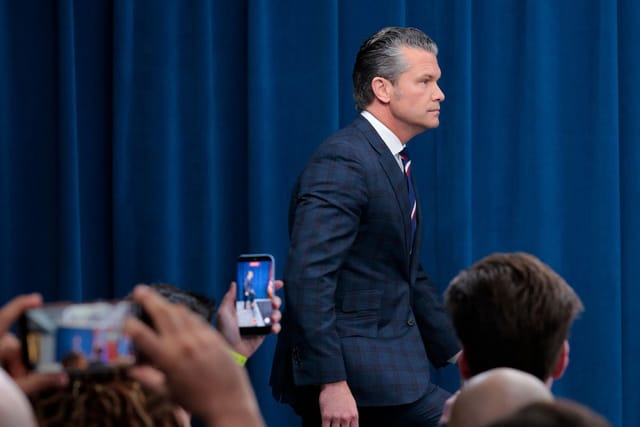
(Photo by Chip Somodevilla/Getty Images)
To:
- Honorable Members of the House of Representatives
U.S. House of Representatives
Washington, DC 20515
Dear Members of the House of Representatives:
The Project On Government Oversight (POGO) is a nonpartisan, independent watchdog that investigates, exposes, and champions reforms on systemic corruption, abuse of power, and waste. We have decades of organizational experience analyzing abuse of power and empowering Congress to hold officials to account.
Drawing on this experience, we recommend that the House of Representatives vote to adopt Representative Thomas Massie’s (R-KY) resolution to impeach Secretary of Defense Pete Hegseth for high crimes and misdemeanors.1 Congress must address Secretary Hegseth’s serious dereliction of his duties, his violations of his oath, his abuses of his office, and his flouting of the law and the U.S. Constitution in full view of Congress and the American people.
Specifically, we urge Members to reject a motion to table the resolution. We encourage Members to vote yes if all eight articles of impeachment are voted on together. If votes are separated by article, we particularly encourage Members to vote “yes” on Articles 1, 3, 4, 5, 6, and 7.
To be clear, however, we believe each of the eight articles individually present valid grounds for impeachment, as we explain in our enclosed analysis.
As this resolution makes clear, Secretary Hegseth has failed in his duty as a constitutional officer, and Congress must hold him accountable for his actions.
Violations of the Constitution and War Powers Resolution
Articles 1, 2, 3, 7, and 8
Secretary Hegseth has repeatedly violated Article 1, Section 8 of the Constitution and Section 2(c) of the War Powers Resolution by sending U.S. troops into hostilities absent an emergency or a congressional declaration of War.
Articles 1, 7, and 8 charge Secretary Hegseth with usurping Congress’s constitutional war powers and acting in violation of Section 2(c) of the War Powers Resolution by launching and sustaining the war with Iran, ordering the military raid to capture Venezuelan President Nicolás Maduro, and overseeing airstrikes in Yemen. None of these actions were taken in response to an emergency caused by an attack on U.S. forces or territory, or with the authorization of Congress.
Article 3 alleges Secretary Hegseth has further encroached on congressional war powers and violated Section 5(b) of the War Powers Resolution by continuing hostilities after the expiration of the 60-day period statutorily allowed for some hostilities.2
Noncompliance with Civilian-Protection Statutes
Article 4
Secretary Hegseth systematically undermined congressionally mandated systems designed to protect civilians in conflict zones, actions that potentially led to the deaths of over 100 children in Iran.
Extrajudicial Killings of Alleged Smugglers at Sea
Article 5
Secretary Hegseth has overseen extrajudicial killings on the high seas that violate domestic criminal laws and the laws of war.
Suppression of First Amendment-Protected Speech
Article 6
Secretary Hegseth illegally retaliated against Senator Mark Kelly (D-AZ) for protected (and truthful) speech about the duty to refuse unlawful orders. Just as importantly, that retaliation may have chilled the speech of other veterans. This is a violation of both constitutional rights and case law.
Some Articles Speak to Imminent Threats
Articles 1, 3, 4, and 5
While we believe that each of the articles is valid, four articles address actions that pose current and ongoing threats to U.S. security and the national interest. In addition to its illegality, the war in Iran is doing serious harm to our military and economy every day it continues. Articles 1, 3, 4, and 5 speak to ongoing military actions and failing civilian protections in Iran, as well as ongoing boat strikes in the Pacific and Caribbean.
Taken together, these four articles allege that Secretary Hegseth poses a current and ongoing threat to our constitutional order, the lives of noncombatants, and the honor of the troops forced to contend with unlawful orders. We believe impeaching Secretary Hegseth on these articles will send an unambiguous message from Congress that these actions must stop now.
To be clear, we also believe that Articles 6, 7, and 8 allege serious, impeachable abuses of power. While the underlying conduct is not ongoing, it demonstrates a long-standing pattern of the Secretary abusing his office.
Conclusion
It is unusual to impeach an official through a question of the privileges of the House. But in this case, the existing record provides ample evidence that Secretary Hegseth has undermined the constitutional separation of powers and violated statutory obligations. The risk posed by his continued leadership argues for swift action.
It is also true that many administrations have pushed the boundaries of military action without Congress’s approval, and Congress has not always responded forcefully. However, past failure to act is not a justification for continued inaction. Rather, it reinforces the duty of Congress to use the present resolution to examine Hegseth’s specific conduct, evaluate it in light of its interpretation of the constitutional principles at stake, and deliver a verdict that reflects the judgement of the institution as a whole.
We understand impeachment is a serious and solemn constitutional power. The evidence shows that Secretary Hegseth has abused his executive power.
His conduct has damaged our constitutional order, needlessly cost lives, and has wasted taxpayer resources on actions that are unlawful and unconstitutional. His leadership and conduct pose an ongoing threat to Americans and allies abroad. We respectfully urge you to vote yes.
Thank you,
Isabel Munilla
Interim Executive Director
Enclosures: 2
Vote Recommendations for Articles Impeaching Secretary of Defense Pete Hegseth
Resources on Impeachment and Secretary of Defense Pete Hegseth
Vote Recommendations for Articles Impeaching Secretary of Defense Pete Hegseth
The Project On Government Oversight believes that there are grounds for the House of Representatives to impeach Secretary of Defense Pete Hegseth.
Should the articles of this resolution be voted on together, we recommend Members vote yes. If articles are voted on individually, we encourage Members to vote yes at minimum on Articles 1, 3, 4, 5, 6, and 7.
Below, we provide POGO’s position on each of the individual articles of impeachment set forth in the resolution.
Article 1: We encourage a “yes” vote.
The Charge
Secretary Hegseth violated the Constitution and the War Powers Resolution by committing troops to hostilities in Iran.
Brief Analysis
Secretary Hegseth’s actions are contrary to the U.S. Constitution and the War Powers Resolution. The scope, duration, and impact of the Iran conflict rise to the level of a war — one which Congress has still not used its exclusive constitutional powers to authorize.3 Additionally, the War Powers Resolution provides only one exception for when a congressional declaration or authorization is required, and there was no national emergency created by an attack on U.S. forces or territory by Iran.4 Therefore, Section 2(c) of the War Powers Resolution was not satisfied prior to the start of the war.
Implicated Law
Article 2: We encourage a “yes” vote if articles are voted on together. If not, POGO does not have a recommendation for this article.
The Charge
Secretary Hegseth violated the Constitution and the War Powers Resolution by continuing the war in Iran after Congress ordered removal of armed forces.
Brief Analysis
A 1983 Supreme Court ruling could raise questions about the validity of the concurrent resolution upon which this article is based. On June 3, 2026, the House passed H. Con. Res. 86, directing the president to remove U.S. armed forces from hostilities with Iran; the Senate passed the concurrent resolution on June 23.5 It is indisputable that Secretary Hegseth has overseen continued hostilities since the resolution was passed. However, the Supreme Court’s ruling on the Constitution’s presentment clause in INS v. Chadha raises unresolved questions about the legal status of Section 5(c) of the War Powers Resolution. Because of the lack of a definitive ruling, we are not making a vote recommendation. But we believe Congress has the right as a coequal branch of government to take the position that 5(c) remains enforceable.6
Implicated Law
Article 3: We encourage a “yes” vote.
The Charge
Secretary Hegseth violated the War Powers Resolution by committing troops to hostilities for more than 60 days without congressional approval.
Brief Analysis
It is clear that Secretary Hegseth has violated section 5(b) of the War Powers Resolution. In certain circumstances, the War Powers Resolution provides the executive branch a 60-day period within which it can commit troops to hostilities without congressional approval.7 That 60-day clock expired on May 2. The administration claimed that hostilities “terminated” in April and then resumed in early July, but even under such an accounting, the clock would have expired in September.8 The war in Iran has clearly exceeded the time limit established in Section 5(b) of the War Powers Resolution, and ongoing actions there are in violation of the law.
Implicated Law
Article 4: We encourage a “yes” vote.
The Charge
Secretary Hegseth disobeyed laws requiring the Secretary of Defense to protect civilians during armed conflict.
Brief Analysis
Secretary Hegseth undermined the congressionally mandated civilian protection infrastructure at the Pentagon, with disastrous results. Congress has specifically required the Secretary of Defense to design programs to protect civilians.9 These mandates align with the Department of Defense’s own laws of war, which require “feasible precautions to reduce the risk of harm to civilians.”10 Media reporting indicates that Secretary Hegseth took steps to radically scale back Civilian Harm Mitigation and Response programs, including those mandated by Congress.11 The impeachment article alleges this likely contributed to the U.S. strike on an Iranian school, which killed or injured over 200 civilians, many of them children.
Implicated Law and Policy
Article 5: We encourage a “yes” vote.
The Charge
Secretary Hegseth violated several laws and the Constitution by authorizing extrajudicial killings at sea.
Brief Analysis
Secretary Hegseth has authorized illegal boat strikes in the Caribbean and Pacific that have killed more than 240 people. There is no framework under which these strikes are legal. The administration has argued that those killed in the strikes are smuggling drugs. However, if these strikes are intended as law enforcement actions, they violate laws limiting the role that military forces can play in such action.12 U.S. law establishes a law enforcement framework for drug interdiction at sea, one that operates through the courts.13 Military strikes against alleged smuggling vessels constitute summary execution of people who are, at most, criminal suspects. If the strikes are intended as military action (setting aside the targeting of likely noncombatants), they violate the Constitution and the War Powers Resolution, as they have not been authorized by Congress.14
Implicated Law and Policy
- 14 U.S.C. § 102
- 14 U.S.C. § 522
- 10 U.S.C. § 279
- 10 U.S.C. § 274
- 10 U.S.C. § 275
- 46 U.S.C. § 70503
- 46 U.S.C. § 70504
- U.S. Constitution, Article 1 § 8
- War Powers Resolution § 2(c), 50 U.S.C. §1541(c)
Article 6: We encourage a “yes” vote.
The Charge
Secretary Hegseth violated the Constitution and the law by leading retaliation efforts against protected speech.
Brief Analysis
In the fall of 2025, Secretary Hegseth openly attempted to retaliate against Senator Mark Kelly (D-AZ) for his lawful and accurate statement that service members do not have an obligation to follow unlawful orders.15 As the article details, the Secretary publicly threatened to recall Senator Kelly to active duty to face a court-martial, issued him a letter of censure, threatened to reduce his rank and pension, and threatened him with prosecution for further statements.16 Using the disciplinary machinery of the Department of Defense to punish a veteran for criticizing its operations is a serious abuse of power, and the Secretary’s threats were clearly intended to chill future speech from Senator Kelly — and potentially other veterans. Such actions are a violation of the Constitution and established caselaw.17
Implicated Law and Caselaw
- United States v. Keenan; United States v. Calley
- Parker v. Levy
- U.S. Constitution, Article 1 § 6
- Bond v. Floyd
Article 7: We encourage a “yes” vote.
The Charge
Secretary Hegseth violated the Constitution and the War Powers Act in the capture of former Venezuelan President Nicolás Maduro.
Brief Analysis
POGO has long maintained that the military raid to capture Venezuelan President Nicolás Maduro constituted an act of war. Days after the raid, we wrote “It is hard to imagine a more clear-cut act of war than launching airstrikes in a foreign country and spiriting away a head of state in the middle of the night.”18 Given that the strike was not authorized by Congress and was not conducted in response to a national emergency caused by an attack on U.S. forces or territories, it is a clear violation of the War Powers Resolution and the Constitution.19
Implicated Law
Article 8: We encourage a “yes” vote if articles are voted on together. If not, POGO does not have a recommendation for this article.
The Charge
Secretary Hegseth violated the Constitution and the War Powers Resolution in the U.S. strikes on Yemen.
Brief Analysis
This article details violations of two separate sections of the War Powers Resolution: Section 2(c), which requires congressional approval for hostilities except in the case of an emergency, and Section 4(a), which requires the President to notify Congress within 48 hours of hostilities commencing.20 There is no question that Secretary Hegseth violated section 2(c) of the War Powers Act by launching military airstrikes against Houthi targets in Yemen without congressional approval. In this instance, messages on a Signal chat that accidentally included a reporter even provide some evidence that top officials, including Secretary Hegseth, were aware that there was no emergency, as they indicated there was no urgent military need to conduct strikes.21 We recognize that the reporting requirement established in Section 4(a) is directed to the President, and it does not require the President to cease hostilities if the reporting requirement is not met. For this reason, we would encourage the House to clarify that the 4(a) charge is not necessary to sustain a yes vote on this article.
Implicated Law
- U.S. Constitution, Article 1 § 8
- War Powers Resolution § 2(c), 50 U.S.C. §1541(c)
- War Powers Resolution § 4 (a), 50 U.S.C. §1543 (a)
Resources on Impeachment and Secretary of Defense Pete Hegseth
The following is a list of resources from the Project On Government Oversight (POGO) relevant to the articles of impeachment against Secretary of Defense Pete Hegseth filed by Representative Thomas Massie (R-KY).
In addition to our organizational focus on oversight and abuse of power, our staff includes experts on Defense Department policy and constitutional law. Our policy and legal analysts are available to discuss the legal and factual bases of the articles of impeachment and provide technical assistance on impeachment procedures in both chambers of Congress.
Constitutional Standards for Impeachment
Resources
Katherine Hawkins, “Congress Can Impeach White House Officials,” Project On Government Oversight, May 27, 2026, https://www.pogo.org/analyses/congress-can-impeach-white-house-officials.
Mort Rosenberg et al., Project On Government Oversight, When Congress Comes Calling: The Limits of Executive Privilege, (December 11, 2025), 6, 21-24, 284-288, https://docs.pogo.org/report/2025/2025-When-Congress-Comes-Calling_Web.pdf.
Justin Rood, Sarah Turberville, and Neil Gordon, “Resources on Impeachment,” November 6, 2019, https://www.pogo.org/resources/resources-on-impeachment.
Contact
Katherine Hawkins, senior legal analyst at The Constitution Project
[email protected]
Violations of the War Powers Act and Article I of the Constitution
Resources
David Janovsky, “The War Clock Never Stopped,” Project On Government Oversight, July 31, 2026, https://www.pogo.org/commentaries/the-war-clock-never-stopped.
David Janovsky, “Trump Must Justify Iran War to Congress Now,” Project On Government Oversight, April 30, 2026, https://www.pogo.org/analyses/trump-must-justify-iran-war-to-congress-now.
Rebecca Schneid, “Did Trump Have the Legal Authority to Strike Iran? An Expert Explains,” Time, February 28, 2026 (interview with David Janovsky), https://time.com/7380309/iran-war-legal-trump/.
David Janovsky, “Airstrikes, Maduro, and the U.S. Constitution,” Project On Government Oversight, January 6, 2026, https://www.pogo.org/commentaries/airstrikes-maduro-and-the-u-s-constitution.
“Iran and the War Powers Problem,” Project On Government Oversight, June 25, 2025, https://www.pogo.org/analyses/iran-and-the-war-powers-problem.
Contact
David Janovsky, acting director of The Constitution Project
[email protected]
Extrajudicial Killings and Violations of the Laws of War
Resources
Plaintiffs’ Opposition to Defendants’ Motion for Summary Judgment and Cross-Motion for Summary Judgment, POGO v. Department of Defense, No. 26-cv-00039 (Dist. D.C. 2026), https://storage.courtlistener.com/recap/gov.uscourts.dcd.288269/gov.uscourts.dcd.288269.19.1.pdf.
Virginia Burger, “Questions Congress Should Ask About Caribbean Boat Strikes,” Project On Government Oversight, January 6, 2026, https://www.pogo.org/analyses/questions-congress-should-ask-about-caribbean-boat-strikes.
David Janovsky, “Guilt by Association: Trump’s Illegal Boat Strikes,” Project On Government Oversight, November 17, 2025, https://www.pogo.org/analyses/guilt-by-association-trumps-illegal-boat-strikes.
Contact
David Janovsky, acting director of The Constitution Project
[email protected]
Katherine Hawkins, senior legal analyst at The Constitution Project
[email protected]
Unlawful Orders and Retaliation
Resources
Greg Williams, “Fact Sheet: Refusing Unlawful Orders,” Project On Government Oversight, December 9, 2025, https://www.pogo.org/fact-sheets/fact-sheet-refusing-unlawful-orders.
Virginia Burger, “Increasing Oversight of the Relief of Military Leaders,” Project On Government Oversight, November 25, 2025, https://www.pogo.org/analyses/increasing-oversight-of-the-relief-of-military-leaders.
Virginia Burger, “Military Oaths and Unlawful Orders,” Project On Government Oversight, November 21, 2025, https://www.pogo.org/analyses/military-oaths-and-unlawful-orders.
Contact
Virginia Burger, senior defense policy analyst at the Center for Defense Information
[email protected]
Costs and Consequences of Illegal Wars in Iran and Venezuela
Resources
William Hartung, “The Iran War Has Cost $2,000 Per Household — So Far,” Forbes, October 18, 2026, https://www.forbes.com/sites/williamhartung/2026/10/18/the-iran-war-has-cost-2000-per--household---so-far/.
William Hartung, “The Costs of the Iran War Will Continue for Decades,” Forbes, September 5, 2026, https://www.forbes.com/sites/williamhartung/2026/09/05/the-costs-of-the-iran-war-will-continue-for-decades/.
Virginia Burger, Munitions: The American Military’s Center of Gravity, Project On Government Oversight, July 29, 2026, https://www.pogo.org/reports/the-american-militarys-center-of-gravity.
William Hartung, “The Costs of the War with Iran Will Mount for Decades,” Forbes, March 4, 2026, https://www.forbes.com/sites/williamhartung/2026/03/04/the-costs-of-the-war-with-iran-will-mount-for-decades/.
Contact
Virginia Burger, senior defense policy analyst at the Center for Defense Information
[email protected]
Signed by:
- Isabel Munilla
Interim Executive Director
Related Content

Congress Must Impeach Defense Secretary Pete Hegseth, Says Nonpartisan Government Watchdog
Congress must hold Secretary Hegseth accountable for trampling on the Constitution and violating the law.